
Dreams From The Dark Years: Anatomy of a Fall
By Paul Hynes.
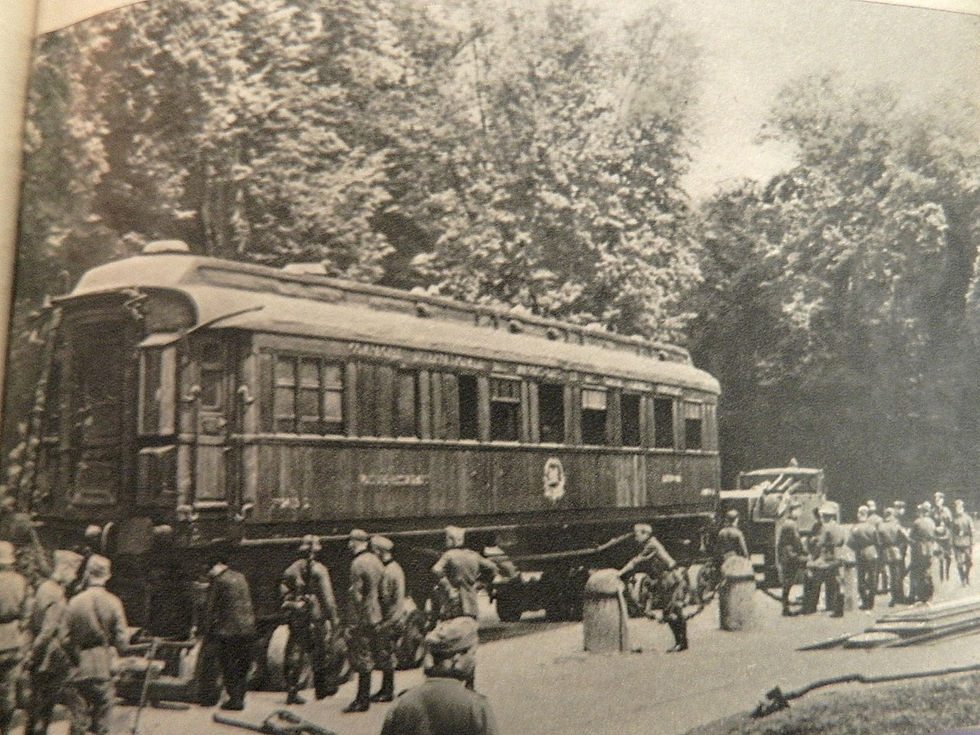
On the 22nd of June 1940, history repeated itself in a tragic manner.
The location was a train carriage in the French forest of Compiegne. At the end of the First World War this wagon had served as the mobile headquarters of the Supreme Allied Commander, Marechal Ferdinand Foch. It was there on 11th of November 1918 that a German delegation had signed the armistice which ended the First World War. It had become a museum exhibit following the war within the Armistice Museum at Compiegne but was now dragged out of retirement and back into history as the setting for a far more sinister ceremony. The Second Armistice at Compiegne would be a sequel even more maligned than the original.
It was here that Nazi Germany would make the French sign the armistice which had been requested and negotiated in the previous days. The ceremony was designed to symbolically undo the defeat of 1918, resentment of which had helped enable the Nazi regime to rise to power. The event was overseen by a gloating Adolf Hitler at the peak of his power. He was so giddy that he allegedly did a little jig.
The French delegation was led by General Charles Huntzinger. When the French Commander in Chief, Maxime Weygand, heard where Huntzinger was he lamented the humiliation of his “poor friend”. Huntzinger was not innocent when it came to the situation France had found itself in. It had been his decision to retreat at Sedan which had enabled the German breakthrough which would eventually reach the Channel Coast.
Had things really gotten so bad that France would have to accept such treatment? Beyond the ritual at Compiegne, the terms of the armistice were far harsher than those imposed on the Germans in 1918. How could anyone agree to such terms?
Fall Rot
Barely a fortnight earlier the final German offensive into France had begun. Fall Rot (Case Red) began on the 5th of June only a few days after the prior German operation, Fall Gelb (Case Yellow), had trapped the best Allied armies in Belgium. Whilst 400,000 Allied troops had escaped via evacuations at Dunkirk and elsewhere, they had left their equipment behind making them useless in the short term. What remained of French forces were outnumbered roughly two to one by the Germans who also now had complete air superiority.
Morale amongst the French troops defending the Aisne and Somme rivers remained high for the most part. They were now in French territory defending their home against the invader and they were confident there were large armies in reserve waiting to relieve them. French High Command had a better understanding of the situation but remained largely confident in their defensive preparations to blunt the German offensive this time. The honour of the French army would be redeemed. What wasn’t clear was whether they were still fighting to bring the war to a victorious conclusion or were simply fighting for more favourable peace terms.
At the centre of these confused aims lay General Maxime Weygand, who had been recalled from his command of French forces in the Middle East and replaced Maurice Gamelin as the Supreme Allied Commander on the 19th of May. Weygand had been Marechal Ferdinand Foch’s Chief of Staff in the First World War and claimed to know the departed hero's secrets for victory. More open to the use of radio and telephone than his predecessor, Weygand had implored the French defenders around Dunkirk to fight to the last round to ensure as many men could be evacuated as possible and to buy time for his own defensive preparations. He continued to shout “Hold on!” to the commander of the Dunkirk garrison until the line had been cut.
Despite his belief in his defensive strategy and appeals to heroic resistance, as early as the 25th of May Weygand had agreed in principle to the notion of a German peace offer. The new French commander warned that fighting on to the end would mean the complete destruction of the French military which he saw as the sole guardian against a Communist revolution. A conservative monarchist who was also deeply anti-German, Weygand saw in an armistice the potential for France to undergo a revitalisation which would eventually lead to revenge against Germany. On the 29th, even whilst compelling his forces to keep fighting he warned how “a moment may well come when France, however willing, may well find it impossible to continue military operations in defence of her homeland.”
At the start of June that moment was imminent. After several days of intense fighting the Germans broke through the French defences on the 9th of June. French attempts to retreat to a new defensive line on the river Seine were overtaken by the German advance. The German crossing of the Seine meant that Paris was in danger of encirclement once more, French Prime Minister Paul Reynaud made the decision to leave the capital with his government, declaring Paris an open city.
Unlike Weygand, Reynaud was a committed republican and had every intention of fighting on; however, he saw no point in fighting a doomed battle which might destroy Paris. He agreed in theory to France exploring peace with Germany but had insisted on consulting with their British ally on the subject. On the 28th of March, shortly after becoming Prime Minister, he had made an assurance to the British that France would not seek a separate peace.
Reynaud and his government would depart an already deserted Paris in a convoy of vehicles on the 10th of June, the French High Command would leave alongside them on a special train the same day.
Flights of Fancy
As Professor Julian Jackson has noted, the appointment of Weygand as Supreme Commander was a grave political miscalculation by Reynaud. Regardless of military success Gamelin was reliably republican and could have been trusted not to push for a surrender as part of a political project.
Reynaud had made an even more severe mistake with the recall of Marechal Philippe Pétain from Spain. He hoped to use Pétain’s prestige to bolster his own government and the French war effort as a whole but would ultimately undo both. Having been effectively retired in his post as ambassador to Franco’s regime, the octogenarian reactionary was now back in the centre of power at the very worst moment.
Reynaud had also brought younger, less defeatist figures into his cabinet such as General Charles de Gaulle, who remained confident in various schemes for holding out against the Germans but at this stage lacked the power or influence that both Pétain and Weygand could muster. The two men had been rivals for much of their military careers but would now work together for the cause of bringing the war to an end in order to rebuild France to their specifications.
Although Pétain and Weygand were the two most prominent figures within the armistice camp it is important to remember many advocates of an armistice simply saw it as an acceptance of reality and a means of ending the suffering caused by the German invasion rather than pointlessly prolonging it. Some sought a compromise where there could be peace in the French metropole but a parallel government could continue the war from the French colonies. Some accepted it on the basis that the war would be over soon anyway, for if France fell then Britain would soon surrender too.
Winston Churchill would arrive at Briare on the 11th of June, the small village on the Loire river was the temporary location of the French military headquarters and would serve as the venue for the penultimate meeting of the Anglo-French Supreme Allied Committee. Churchill would attempt to renew French confidence delivering his usual defiant rhetoric in a mix of English and French. He expressed support for a plan proposed by de Gaulle to hold out in Brittany, comparing it to similar strategies the British had used in Portugal during the Napoleonic Wars. It perhaps wasn’t the best analogy to use for a French audience and Weygand dismissed the Brittany plan as impractical.
Churchill would attempt to draw on memories of the First World War with Pétain, reminding the Marechal how they had both faced a similar German breakthrough in the Spring of 1918 but their nations had held their nerve and emerged victorious. Pétain replied that on that occasion it had required 40 French divisions to check the German breakthrough but now after successive defeats the French army only numbered 40 divisions as a whole.
Britain could offer little in the way of reinforcements, only one division could be sent in the near future and no more aircraft would be coming. Churchill accepted that France might have to make a separate peace but nonetheless attempted to make it clear that Britain would keep fighting even if France were to capitulate. The aim was to impress on the French that fighting on from their empire would be a viable option.
Both Reynaud and de Gaulle maintained some confidence of holding on to a portion of French territory but were also willing to accept the notion of fighting on from the empire. This appeared to be the majority opinion of the French government. When Weygand formally asked for an armistice on the 12th June, it was rejected despite Pétain’s support. Churchill and Reynaud agreed to make an appeal to the United States for further support before contemplating the idea of an armistice.
Churchill then returned to London once more on the morning of the 13th without addressing the wider government as many of Reynaud’s ministers had expected. The notion Churchill had stood them up weakened the support for fighting on from North Africa as did Reynaud’s leadership. It is difficult to estimate what degree the British could be trusted, their behaviour over the previous weeks had often appeared self-serving. Pétain now delivered a statement to the government ministers he had been preparing over the last few days. With Churchill’s failure to show up he had the opportunity to make his views abundantly clear.
Dressed in full military uniform, Pétain stated that if an armistice was not secured then French troops would soon start to ignore orders and chaos would follow. He argued the government must stay in France to share in the misery that the French people would now have to endure and expressed scepticism of the notion of fighting on from overseas and waiting for liberation from an allied power at some unspecified moment. He warned that he would personally stay in metropolitan France even if he had to resign in order to do so. Having been brought in to bolster Reynaud’s government, Pétain was now subtly threatening to topple it by resigning if he didn’t get his way.

A Desperate Proposal
The continuing German advance forced the government to move once more on the 14th of June, this time to Bordeaux on the southwest coast far from the German advance. The situation was nonetheless time sensitive, French forces were in retreat everywhere. The choice had to be made between capitulation or evacuation before neither was an option. Unlike Briare or Tours, Bordeaux was a large city where the government could properly function. It also gave those who supported an armistice the chance to organise and build support for their position. The Mayor of Bordeaux, Adrien Marquet, was a Fascist sympathiser and provided this faction with every resource they required.
On the 15th of June Reynaud formally proposed that the government depart for Algiers. The Algerian capital would be much safer than Bordeaux and at this time Algeria was considered formally part of French territory. Nonetheless it would involve leaving metropolitan France and was met with a mixed reaction, including from the French Naval Minister Admiral Darlan.
Darlan was considered a liberal republican figure in favour of fighting on from the colonies but had begun to doubt the practicalities. Hundreds of French aircraft were already departing for North African airfields whilst the most powerful units of the French fleet had already sailed to the Algerian port of Mers-el-Kébir. However, there were few troops left in North Africa or elsewhere and evacuating those in France would require time which the French were quickly running out of. Darlan had told Weygand that no British support for North Africa could be expected for several months by which time it might already have been overrun.
An alternative proposal was made to appoint a prominent neutral figure (the Pope or President Roosevelt were floated as candidates) to approach the Germans to investigate what peace terms they might offer France. It was vague enough to gain widespread approval.
On the 16th of June the British gave their consent to the French seeking terms on the condition that the French fleet would be interned at British-held ports for the duration of the war. Churchill offered a bizarre alternative, merging France and the UK into a single Franco-British state which would allow the French to continue the war as equal partners even if metropolitan France was temporarily overrun. Like most marriage proposals made with the aim of rekindling failing relationships, it was doomed. The French rejected it on the suspicion that the offer was really a ploy by the British to absorb French colonies.
A response to Reynaud’s appeal for American intervention also came on the 16th. President Roosevelt pledged continued support provided France fought on but refused American entry into the war. For Reynaud it meant the exhaustion of his proposals and his government. He resigned that day in frustration. Reynaud did not see this move as the end of the argument, rather a means of forcing those who favoured dealing with Hitler to confront the reality of what German terms would look like. When explaining this plan to the American diplomat Tony Biddle, Reynaud noted, “I only hope they won’t be too moderate.” Once the severity of German demands became clear, fighting on from abroad would surely be the only option.
In reality Reynaud had decisively handed the initiative over to those who favoured dealing with the Germans. At the greatest moment of crisis for his country, Reynaud had proven himself incapable of rising to the challenge. Nonetheless, cometh the hour…
“The destiny of the world is here”
It seemed there was only one man to replace Reynaud, one man to end the suffering in France and make harsh German peace terms palatable. Marechal Philippe Pétain stepped into the leadership role which had been arranged for him by more skilled political operators in the last few days. After over a decade of being hailed as France’s saviour he was in power at last. He acted decisively and disastrously.
The Spanish were soon asked to make contact with the Germans and ask for peace terms. On the 17th, Pétain made his impression of the situation clear to the French people via the radio and stated that “with a heavy heart” it was necessary to stop fighting and to ask the enemy for terms.
The speech was a source of relief to many French people who had already come to this conclusion and many even found comfort that a celebrated and respected figure such as Pétain was now at the helm. The speech also caused a great deal of confusion, particularly within the French army, that an immediate cease-fire was in effect. Thinking the war was already over they began to surrender en masse. Pétain would quickly issue a clarification but the damage was done.
Having warned of the collapse of the French army, Pétain had now caused it. Of the almost two million French prisoners of war taken by the Germans the majority surrendered during the period between Pétain’s speech and the signing of the armistice. The plight of French POWs would become one of the primary political issues facing the Vichy regime and a personal obsession for Pétain, perhaps in part for his role in expanding their numbers. The scale of the disintegration also left what remained of unoccupied France practically defenceless.
The Germans had not yet reached Bordeaux but Pétain was also causing chaos there. On the same day as his speech, he had ordered the arrest of Reynaud’s Minister of the Interior, Georges Mandel, on allegations of conspiracy. There is still no clear conclusion on what motivated this arrest although it is hard to escape the fact that Mandel was an outspoken proponent of fighting on as well as being Jewish. The arrest provoked an uproar from those within the government who still upheld parliamentary democracy, including the President who demanded Mandel’s release. Pétain ordered Mandel freed immediately and issued an apology.
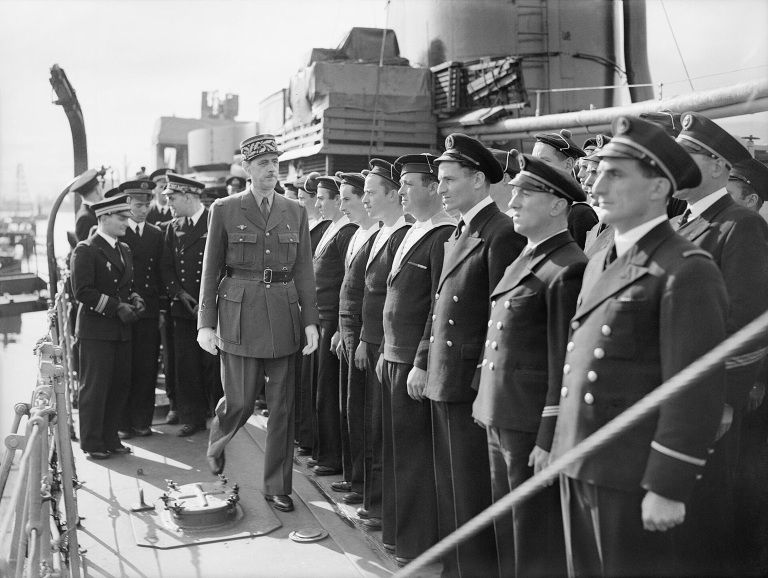
Pétain would survive this scandal and, as will be seen, Mandel and his allies would soon become embroiled in their own controversy, but for General Charles de Gaulle it was a pivotal moment. The young officer had been removed from the cabinet by Pétain and whilst his enmity for the Marechal had always been more personal than political, the arrest of Mandel did not bode well for other opponents of the new government. On the night of the 17th he would leave for London. He would not return to metropolitan France for four years.
The following evening de Gaulle would address the French people for the first time. Where Pétain had spoken in a muddled and weary resignation, de Gaulle offered defiance. He made his calculation clear: yes the battle was over in metropolitan France but the French empire was intact. The United Kingdom was undefeated and alongside the French fleet could continue to control the seas and use American industry to rebuild the Allied armies. He invited all Frenchmen who could make it to join him in London to continue the fight.

Allowing this broadcast had been questioned by some within the British government who feared giving a platform to this minor, unknown figure would risk upsetting the legitimate government in Bordeaux. The speech was also barely heard by anyone within France but it was hoped de Gaulle’s speech would provide a rallying cry for more senior figures in control of much larger forces. In North Africa the Commander of French forces, General Charles Noguès, made it clear he believed his armies could hold out indefinitely whilst earlier in June Admiral Darlan had stated in the event of an armistice he would sail the fleet to London. De Gaulle at this stage was merely a stalking horse. The general had declared that the destiny of the world was centred in London but for the moment the fate of France was being decided in Bordeaux and Munich.
The Armistice(s)
France remaining partially in the fight was also a major concern for the Germans. Shortly before de Gaulle made his broadcast Hitler had received Mussolini in Munich to discuss the French peace feelers.
Italian troops in the French Alps had barely moved but the Italian dictator had severe demands in mind. Hitler however was uncharacteristically cautious and feared French colonies or ships continuing the fight from overseas. What he wanted was to offer ‘lenient’ terms and secure a French exit from the war in order to isolate the UK and force them to negotiate in turn. The Italian Foreign Minister, Galeazzo Ciano, compared the German dictator to a gambler who had just achieved a big win. Having won big at the table he was keen to withdraw before his luck ran out.
Mussolini remained stubborn but Germany had defeated France almost singlehandedly and the Italian dictator’s bargaining position was weak. He would agree to the lenient approach with great bitterness particularly over the German refusal to negotiate alongside the Italians. The Germans had rejected this on the basis that they had many dealings with the French which did not concern Rome. With Italy having only been in the war for a few days the Axis alliance was already looking rather lopsided.
The Germans communicated their willingness to negotiate on the 19th of June. The negotiations would begin the following day in the location the Germans had chosen, the forest of Compiegne. The French delegation would be headed by Charles Huntzinger, having played a key role in failing to halt the disastrous German breakthrough in May he was now responsible for the consequences in June. Before Huntzinger left Pétain instructed him that should the Germans demand any portion of the French colonial empire or fleet then the negotiations were to be terminated. The French delegation arrived to a triumphant scene of swastika flags and Hitler himself.
What does ‘leniency’ involve in the mind of a genocidal despot? The German delegation was led by Field Marshal Wilhelm Keitel, the head of the German High Command. Despite the setting for the negotiations the German demands began with praise for the “heroic resistance” of the French and a wish to avoid humiliating “an enemy so brave.”
It was the only time Nazi Germany would offer such terms, allowing a defeated enemy to maintain part of its territory and a certain amount of independence. The conditions were harsh nonetheless. Two thirds of metropolitan France would be occupied including Paris and the entire Atlantic coast. France would have to pay the costs of this occupation and collaborate with the German army in maintaining it. The French would have to hand over all German nationals residing within France.
The remainder of France, a rump ‘Free’ zone in the south, would be entirely under French jurisdiction. The French military would be restricted to 100,000 men without heavy equipment and a meagre air force under German supervision. The remainder would be demilitarised with the equipment handed over to the Axis. The French fleet would return to ports within the German occupied zone to be disarmed although the terms emphasised that the fleet would remain French and that no claim would be made against any ships. Similarly, the armistice would leave the French empire intact.
Keitel demanded Huntzinger sign immediately but the French General insisted on consulting with Bordeaux which he would do several times. The following negotiations on the 21st achieved only minor concessions; the French would be allowed to scrap demobilised aircraft rather than hand them to the Germans and some industry would be allowed to move into the Free Zone. The Germans refused to budge on the other demands and Keitel grew impatient, threatening Huntzinger that the German offer would expire at midnight on the 22nd.
Although the terms were severe, they did not break any of the conditions Pétain had set for rejecting an armistice. Despite his opposition to the armistice, General Nogues followed Weygand’s orders to arrest those who wished to carry on the fight from North Africa. Admiral Darlan also gave his support; when challenged on his earlier comments about sailing the fleet to England he replied that it was too late and the British would soon be asking for terms themselves.
Huntzinger signed the armistice on the evening of the 22nd and departed for Rome. The peace between France and Germany would not come into effect until terms had been agreed with the Italians as well. The French delegation had been bitter about this; they did not consider France militarily defeated by Italy. Fighting raged on in the Alps where an Italian offensive launched on the 21st had made only minimal progress.
Nonetheless the Italian terms were surprisingly moderate. In accordance with what had been agreed at Munich, Mussolini had tempered his demands to territory which Italian troops had already occupied. This amounted to some small strips of Alpine territory including a few villages. The Franco-Italian Armistice was signed at a villa on the outskirts of Rome on the 24th of June. At the price of six thousand casualties Mussolini had gained around thirty thousand new Italians.
The peace made at Compiegne and Villa Incisa came into effect on the 25th of June. Most French people, exhausted and terrified, greeted it with relief. In some places south of the new demarcation there was even celebration as the Germans ended their brief occupation and the tricolour was once again raised over the new Free Zone. However, in many other places the Germans arrived where they hadn’t been before. This included Bordeaux, forcing the French government on the road once more. Pétain’s new government looked for somewhere they could base themselves temporarily until they were able to return to Paris. The spa town chosen for this ‘temporary’ seat of power would give the name to his new regime which would soon become infamous.
Guilty Men
This article has provided an overview of the events and decisions which placed a leadership in power in France which felt surrendering to the Axis powers was preferable to fighting on. It was borne of political crisis as much as military defeat. It was a decision borne of defeat and desperation but also of a desire on the part of some to bring about the conditions for a fantasised national rebirth at almost any price.
Those who wished to fight on are not blameless, refusing to act on their beliefs and ceding power when there was no requirement to do so. It is clear there would have been challenges to face if France had fought on, perhaps even insurmountable ones, but most didn’t even bother to try. The most politically adept among them would spend many months howling at the wind across the Channel due to the failures of his peers. De Gaulle would eventually return to France in triumph as the leader of the nation but by the end of June 1940 he was an isolated dreamer.
Was a world without an armistice really such a fantasy? If not, which decisions might have gone differently to enable it to happen? How would the war have unfolded if the Free France of de Gaulle’s dreams became reality? Next time we will examine what might happen had France fought on.
Paul Hynes is the author of the Decisive Darkness series and the Red Fuhrer series.


Comments