
Review: Doctor Who: Deathworld
By Matthew Kresal.
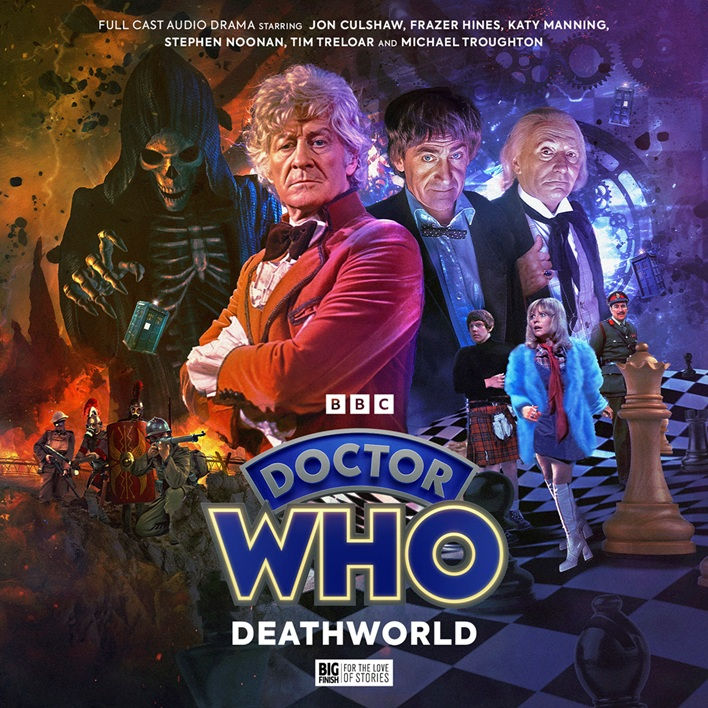
For Doctor Who’s tenth season, the programme celebrated a decade on-screen with a serial featuring the three actors who had played the Time Lord. But while The Three Doctors as broadcast primarily focused on the Jon Pertwee and Patrick Troughton incarnations (ill health left William Hartnell in a supporting role) as they faced off against the vengeful Time Lord Omega, the tenth anniversary serial was almost a very different story. One that would have seen a larger role for Hartnell’s Doctor, a returning companion, and the three Doctors facing off against a personification of death itself. Fans would have to wait more than a half-century to discover what could have been in Deathworld.
Like its produced TV counterpart, Deathworld’s origins lie in the early planning for that tenth season. Producer Barry Letts and script editor Terrance Dicks looked to start each of their season with what Letts termed a “hook,” something which would draw in viewers. Each of Pertwee’s seasons had one: Season seven in 1970 saw his introduction (though Letts came onboard only after filming was completed), season eight saw the introduction of Roger Delgado as the Master, and season nine saw the first serial to feature the Daleks in the series since 1967. With Doctor Who now a decade old, Letts and Dicks settled on the multi-Doctor approach. Approaching regular series writers Bob Baker and Dave Martin while confirming that Hartnell and Troughton were interested in returning to the series, work began on the script.
On the 3rd of February 1972, Baker and Martin delivered an outline entitled Deathworld. In it, the Time Lords would come under threat from a personification of Death itself, challenging their dominion over time. The Time Lords would have the Doctors act as their champions, with the three incarnations (alongside companions Jo Grant and Jamie McCrimmon plus UNIT’s Brigadier Lethbridge-Stewart) eventually sent to face Death and his allies inside his reality. There, separately and together, they would face representations of death including personifications of the Four Horseman of the Apocalypse, the Seven Deadly Sins, and mythological monsters.
No sooner did Deathworld arrive in the Doctor Who production office before changes began to be made. Though Hartnell had indicated a willingness to return to the series, his wife Heather soon alerted Letts that he’d caught her spouse on a good day with the arteriosclerosis that had helped force his departure from the series in 1966, limiting his memory and performance. Troughton would not be available until to film until November 1972, requiring the serial’s production dates to be moved. The recording dates clashed with the availability of Jamie actor Frazer Hines, who at the time was one of the stars of the soap Emmerdale Farm. On top of the changes necessitated by availability and circumstances, Baker and Martin’s use of Death (briefly re-christened as OHM, which is “WHO” turned upside down) and mythological figures didn’t meet with Letts’ approval.
The changes took shape over the spring and early summer. By September, Deathworld had instead become a desolate planet in an anti-matter universe inside a black hole and the foe had become Omega. Hartnell’s appearances would be limited to brief appearances largely seen on the TARDIS scanner screen, filmed in a single November day with a seated Hartnell reading from cue cards. Rechristened The Three Doctors, the serial opened the season on December 30th (technically closer to Doctor Who’s ninth anniversary!) and would bring the series its highest viewing figure since 1965’s The Web Planet.
Over the years and decades that followed, however, details of the serial that might have been surfaced. More often than not they came out in relation to The Three Doctors, including in the DVD audio commentary with Letts discussing details with actors Katy Manning and Nicholas Courtney (Jo and the Brigadier, respectively) and, later, the making-of documentary produced for the serial’s special edition DVD release. The door for a fuller version of Deathworld finally opened when Big Finish Productions launched Doctor Who – The Lost Stories in the late 2000s. After years on a backburner, August 2024 would see Big Finish offer fans the opportunity to hear Baker and Martin’s original plans for themselves, with Deathworld being only the second Pertwee era script produced for the range after The Mega in 2013.
Adapted by Lost Stories veteran John Dorney, Deathworld showed just how far both Big Finish and the range had come in the previous decade. Whereas The Mega had been produced as an enhanced audiobook with Manning and Richard Franklin voicing the Doctor and Brigadier in narration alongside reprising their original TV roles, Big Finish had since wholeheartedly embraced the idea of re-casting roles where the original performer had passed away. The result was a full cast audio with Stephen Noonan voicing Hartnell, Michael Troughton taking on his father’s Doctor, and Tim Trealor taking on Pertwee’s, with Jon Culshaw voicing the Brigadier. All four had played these roles in other Big Finish ranges, though this marked their debuts in the Lost Stories range, something which meant that Dorney and director David O'Mahony could present something closer to what audiences might have gotten in 1973.
Dorney, like Simon Guerrier adapting The Mega, faced a major challenge. As he explained in Big Finish’s promotional magazine Vortex at the time of its release, “I didn’t have a massive amount to work from. I had a couple of pages and various things I found in other publications that suggested revisions and drafts that I couldn’t track down.” As he had when facing a similar situation adapting the proposed but unmade Ice Warriors origin story Lords of the Red Planet, Dorney combined elements from the various sources to flesh out the fuller story, recognizing as he told Vortex that, “you can see the ideas and how they led to what we actually saw on TV in The Three Doctors, but at the same time it’s noticeably different as the style is a lot more fantasy-based.”
Listening to Deathworld, the roots of what became The Three Doctors are apparent. There’s the assault on UNIT HQ in the opening instalment, the Brigadier being thrown in with an earlier incarnation of the Doctor (as well as his bewilderment, played less slightly for laughs here, at discovering him wearing an older face), and Omega’s Gell Guards filled the role of mythological creatures. Death and Omega fill similar narrative roles and Death’s castle feels like what Omega’s fortress might well have been intended to be before budgets (and filming in a quarry) lessened its scale. Roots, or rather a seed, that fans of Classic Who will recognize.
Even so, Deathworld isn’t merely The Three Doctors with Death in place of Omega. From the opening scene invoking the film The Seventh Seal, with Death and the female Time Lord President playing a variation of chess at the edge of an alien sea, the tone is less action-adventure and something more fantastical. Something which is not surprising given that Baker and Martin often started with such imagery that had to be toned down by script editors; famously their debut serial The Claws of Axos started life with a skull-shaped alien spaceship touching down in the middle of London. As the serial moves to a zombie horde attacking UNIT HQ before shifting to the titular reality in the second episode, the imagery of horror and fantasy becomes increasingly pronounced. By the time the Doctor face the Four Horsemen and the Seven Deadly Sins, Deathworld has moved firmly from science fiction and into something very close to outright fantasy. Something that the series had done on occasion such as in The Mind Robber and it works surprisingly well here. But, as Letts might have sensed, it’s perhaps not the thing to celebrate the tenth anniversary of what is meant to be a science fiction (not fantasy) television series.
In fleshing out Baker and Martin’s original storyline, Dorney was able to transcend the issues of health and availability that so impacted The Three Doctors. The Hartnell Doctor is present as a third lead throughout, taking on his own subplot in the middle episodes and appearing alongside the Brigadier (neatly referencing that Nicholas Courtney had appeared as a different character during Hartnell’s tenure). Frazer Hines as Jamie also gets to appear alongside his Doctor, the chemistry between the two characters wonderfully intact and celebrated. Jamie and Jo also have plenty of chemistry between them and a hint, perhaps, of what might be something more if only time and space would align just right. Alongside the banter and arguing between the three Doctors that echoes the The Three Doctors, it’s the sort of anniversary serial tradition that would only come to the fore a decade on with The Five Doctors. Dorney’s script offers listeners a peak across timelines to a time and place where circumstances allowed those tropes to arrive sooner than they did for us.
Not that all is perfect, as the concluding scenes see Dorney having his cake and eating it too. Deciding unlike with The Ark and Return of the Cybermen not to let Deathworld exist in an Unbound continuity of its own, Dorney arranges (or contrives, if one wishes to be less forgiving) circumstances to instead still allow The Three Doctors to occur as it did on-screen while also lampshading the similar events in both serials. Dorney had played with a similar idea in Return of the Cybermen to allow it and Revenge of the Cybermen to both play out only for it to be cut before recording, and reading Dorney’s intended scene (posted to twitter) for that release, it works better than what he wrote for Deathworld. It’s perhaps a case where simply letting this stand on its own might have been the better route.
As is often the case with Big Finish’s productions, Deathworld benefits from how solidly made it is. Tim Steemson’s sound design and score feel sparse in places compared to some of Big Finish’s more recent output, but what’s present both evokes the era nicely but more importantly serves the story being told. Not to mention aiding the cast in bringing the script to life and what a cast there is here with the main cast, including the Doctors and Culshaw’s Brigadier, all benefiting from having honed their performances in other ranges. Each of the Doctor’s neatly capture their original performers, with Trealor and Troughton nimbly featuring the spirit and energy of their predecessors while also on occasion offering very close vocal matches. Noonan’s take on Hartnell captures more of the mannerisms, the ‘hmms’ and invoking the testiness of the characterization than offering a precise soundalike but still presents a credible version of that Doctor. Meanwhile, Jon Culshaw provides an impeccable recreation of Nicholas Courtney as the Brigadier, making it easy to imagine Courtney back in uniform and playing the part for less comedic effect than in The Three Doctors. Backed by Manning and Hines reprising their TV roles plus a supporting cast including Joe Shire as a richly voiced personification of Death and the Four Horsemen plus Dianne Pilkington as the Time Lord President, it’s something that makes it possible to imagine what we might have gotten in the winter of 1972-3. (The President is a forward-thinking piece of cast that may or may not have been how a 1970s version on TV might have gone, as there’s a male President in The Three Doctors but a female President of Earth in Frontier in Space later that year)
All things considered, is Deathworld a better serial than The Three Doctors? It certainly makes more use of one of its leads and having Jamie present and correct alongside Troughton goes a long way to add to the anniversary feel. Yet it’s also more fantasy than science fiction and, with its cast of Horseman, Sins, and monsters, almost certainly something that would either would have broken the show’s budget wide open or produced something remembered for all the wrong reasons (i.e. low quality and dated visual effects) decades later. As a well-made audio drama, what Deathworld offers listeners a peak into a timeline where Hartnell’s health is stronger, Hines could take time off Emmerdale Farm, and Letts was more willing to indulge Baker and Martin’s fantastical vision. A different world, to be sure, but whether it would have been a better one is in the ear of the listener.
But here’s a parting thought: In a world without Omega, however, would Death have appeared in Modern Who’s The Reality War instead?
Matthew Kresal is, among other things, the author of the SLP book Our Man on the Hill and short stories in the anthologies AlloAmericana, The Emerald Isles, and The Scottish Anthology.

Comments