
Review: Doctor Who: Nightmare Country
By Matthew Kresal.
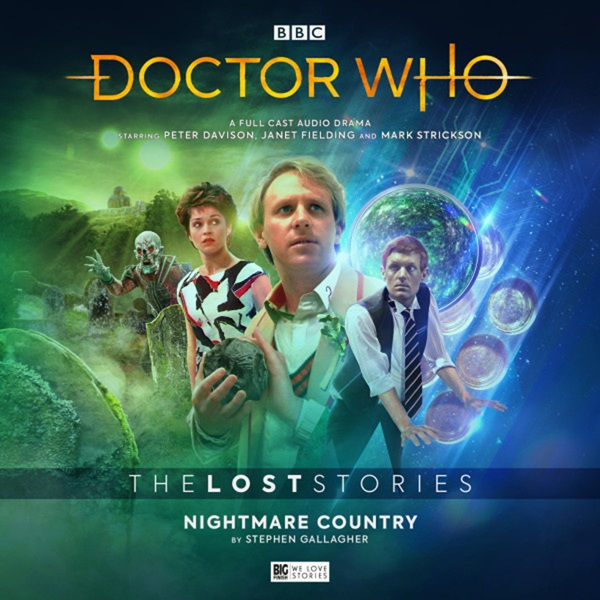
In light of how Doctor Who spent the second half of the 1980s, it feels safe to say that Peter Davison’s tenure in the TARDIS was the last period of both popularity and stability that its 20th century incarnation enjoyed on television. Even so, the early 1980s left behind a number of unmade serials in its wake as script editor Eric Saward sought writers who could contribute to the series. Among the casualties was a storyline called Nightmare Country from a returning up-and-coming writer, Stephen Gallagher. It would soon become an intriguing “what if?” for fans of the series before finding an eventual home on audio thanks to Big Finish’s Lost Stories range decades after its initial rejection. Did viewers miss out on a potential classic in 1984?
Gallagher had twice previously contributed to the series. The first story, 1980’s Warriors’ Gate, was a high concept script brought to life via a heavily reworked script and an exceedingly fraught production during Tom Baker’s final season on the series. Though Gallagher was not pleased with how his script had been brought to life and was vocal to the Doctor Who production office about the fact, incoming script editor Eric Saward nonetheless commissioned a second serial from Gallagher. Terminus would be produced as part of Davison’s second season, which also marked the series 20th anniversary, something which necessitated Gallagher having the villainous Black Guardian present in his script. He also set up the exit of Sarah Sutton’s Nyssa as well. Though Terminus faced production issues, none of them seemingly resulted from Gallagher’s script, with the production team open to further pitches from the writer.
In late 1982, before Terminus had aired, Gallagher made his pitch for Nightmare Country. As Dave Own would note in Doctor Who Magazine 296 nearly twenty years later, Gallagher opened by “eschewing such familiar establishing techniques as the Doctor answering a space SOS, deciding to visit an old friend or simply landing on a strange planet and going to explore.” Instead, Gallagher began with the Doctor awakening in an environment akin to “an endless nineteenth century graveyard,” with no solid memories or idea of how he had arrived there. The Doctor eventually encounters a seemingly shipwrecked group, trying to repair their spaceship and escape the Vodyani. The Vodyani, described by Gallagher as “bony creatures” who live underground, are tormenting and attacking the scavengers, capturing them so that the Vodyani can experiment upon them. The Doctor gets caught up in the struggle, trying to make sense of the world he finds himself in.
A world that makes little sense because, as viewers would discover via the Doctor’s companions Tegan and Turlough, it was being constructed. The Doctor is inside the TARDIS, where “screened behind a temporary wall of glass, he and about half-a-dozen others are sitting around an oval table with spotlights overhead. They're all wired into a machine in the next room, also behind glass.” The “others” are Engineers, technological nomads seeking to create a world of their own whom the Doctor is helping out via the use of his TARDIS (which is receiving an overhaul as part of the process). Only the world their living minds is supposed to be creating isn’t a paradise, with the race soon on to discover both what has gone wrong with the process and to extract the Doctor and the Engineers before things turn fatal.
Gallagher was pitching, in a sense, a cyberpunk tale set inside the TARDIS. Something made all the more remarkable that the writer was doing so at a time when that subgenre was still emerging and that it would have aired the same year that William Gibson's novel Neuromancer was published. Which, along with its ambitious scope, meant it didn’t find a warm reception when it arrived in the Doctor Who production office. Recalling Saward’s reaction on the 2019 CD extras, Gallagher noted being told that what he had was a "million-dollar movie," and something beyond the capabilities of the show's makers. Gallagher would move onto other projects as both a scriptwriter and novelist including adaptations on radio and screen of his novel Chimera and UK and US TV versions of his “science-based” thriller series Eleventh Hour, but never again returned to write for Doctor Who on television.
Nightmare Country was destined not to fade into utter obscurity thanks to issue 296 of Doctor Who Magazine. As well as Owen’s piece, it reproduced Gallagher’s pitch in full. This showed a story that wasn’t without its weaknesses (things that, as Owen noted, could have been dealt with later in development, such as the Engineers all being either elderly or quite young with no age range in-between) but that it was also well within the capabilities of the BBC with the “tombs and catacombs of the cemetery world would be as easily achievable in studio as the catacombs of Ribos,” which had featured in the 1978 Tom Baker serial The Ribos Operation.
Less than a decade later, it appeared that there might be a way for Gallagher’s pitch to come to life. In 2008, Big Finish Productions began a new range of releases under the banner of The Lost Stories. By the range’s initial end in 2013, three serials with Davison’s Doctor had been produced but Nightmare Country wasn’t among them, perhaps owing to Gallagher’s TV work throughout the period. With Big Finish’s 20th anniversary of audio dramas based on the series approaching for 2019, the company revived The Lost Stories for two additional releases. Nightmare Country would be one of them, released in November 2019 alongside The Ultimate Evil featuring Colin Baker’s Doctor.
Was it worth the wait? It certainly was.
Gallagher learned from past experiences with Warriors’ Gate and Terminus, playing with big ideas but in an accessible fashion. Nightmare Country could easily have left listeners in the dark alongside the Doctor but doesn’t, instead using that to set up two mysteries in one. It also does something rather important: it takes time to explain what’s going on, especially in the final episode where those ideas become crucial to the resolution. Gallagher, too, developed aspects of the pitch further, alleviating many of the issues that Owen cited in his Doctor Who Magazine piece nearly twenty years earlier. That included the ending where Gallagher was able to make a tweak that paid off the emotional core of the story better than his 1982 outline had. The result is rather intriguing in that Nightmare Country feels not like a relic from another era but ahead of its time, featuring as it does pre-echoes of films such as Dark City or Modern Who episodes such as Extremis.
The strength of Gallagher’s writing is also clear in the characters and dialogue, which carries over into the performances. The TARDIS crew is especially well drawn and better so than some of the scripts that actually made it over to TV. Davison in particular is on fine form as the Doctor, albeit one with his memories missing for much of the serial yet lives up to longtime Who writer Terrance Dicks' adage that "the Doctor is always the Doctor." Janet Fielding as Tegan remains as feisty as ever, but both Gallagher's writing and her performance give the character something she so often seemed to lack on TV: heart. The interactions between the two of them in the latter half of the story, and their last scene together, shows a depth that was missing on-screen. Even Mark Strickson’s Turlough gets a chance to shine, given something to do besides crawling around ventilation shafts and complaining as was all too often the case with the character on TV.
The supporting characters are solid, especially Ian Conningham as Master Engineer Konis and Edward Dede as his apprentice Volos who are the most memorable. Director Ken Bentley employs a small cast, including Big Finish regulars Tracey Wiles and Beth Chalmers, well to fill out multiple roles that only the most attuned listener would pick-up upon. All of which aids in bringing Gallagher’s script to life in superb fashion.
The icing on the cake is the score from Andy Hardwick. The 1980s was an electronic period for Doctor Who musically, with the Davison era showing the great range in terms of composers (often drawn from the BBC Radiophonic Workshop) and how effective their work could be. Hardwick taps into the stronger scores of that era, such as Roger Limb's for Davison’s swansong serial The Caves of Androzani, to produce an immensely evocative audio soundscape. It feels perfectly in keeping with the era but also serves Nightmare Country as a story well, complimenting the performances and Hardwick’s own sound design work. The inclusion of an eight-minute music suite as an extra is an added delight, especially for fans of Doctor Who music, allowing listeners the chance to enjoy Hardwick's work on its own.
Did Doctor Who fans and viewers miss out in 1984? Given the strengths of Gallagher’s script, the performances from the era’s cast, and Hardwick’s score, the answer is almost certainly. It is intriguing to think what might have happened if Nightmare Country had gone out during that final Davison season or, as almost happened with The Space Whale aka The Song of Megaptera, a modified version of it had made it into Colin Baker’s tenure. Perhaps Dave Owen’s thoughts from that 2000 Doctor Who Magazine piece says it best: “What Nightmare Country has is a strong, unambiguous vision, and - after some important revision - deserved to have been realised more than several, at least, of its contemporaries. A shame.”
But a shame that has now been somewhat corrected by Big Finish’s 2019 production.
Matthew Kresal is, among other things, the author of the SLP book Our Man on the Hill and short stories in the anthologies AlloAmericana, The Emerald Isles, and The Scottish Anthology.


Comments