
Review: Doctor Who: The Hollows of Time
By Matthew Kresal.

On the 27th of February 1985, Doctor Who was officially and quite publicly put on hiatus. The two years that followed were among the most dramatic in the series history, with an entire season worth of serials being scrapped in favor of an overarching narrative even before behind the scenes events played out in the public eye in fandom and the larger British press.
Among the scripts for what could have been Colin Baker’s second season in the role (and Doctor Who’s 23rd season) was a serial from the keyboard of a former script editor, featuring a monster from his previous televised serial and another returning foe. A serial that would, a quarter-century later, get its chance as an audio drama as The Hollows of Time.
Sort of.
The Hollows of Time began life some eight months before the hiatus took place. Christopher H. Bidmead, who had served script editor of Doctor Who during Tom Baker’s final season before authoring two additional two serials for Peter Davison, had continued to submit to the production office under his eventual successor, Eric Saward. Saward, always looking for reliable writers who both understood the difficult to write for series and capable of delivering scripts, once more turned to Bidmead in June 1984 with a commission. Drawing on Bidmead’s interest in real science (and in this case physics), the storyline for In the Hollows of Time would feature the return of the Tractators, his gravity controlling monsters that he’d introduced in the serial Frontios broadcast earlier that year.
Saward was happy enough by that November to commission scripts from Bidmead for a serial of two 45 minute episodes, which had now dropped the “In” from its title. Bidmead, who’d come from a radio background, felt that he was at last shedding that influence and was writing a serial built around what a visual production and the BBC’s visual effects department could accomplish. Set to be produced as the fifth serial in the season, the serial had director Matthew Robinson opener assigned to it and all appeared to be well.
Then came the hiatus. Saward and producer John Nathan-Turner had initially intended to keep The Hollows of Time for the eventually produced season, going so far as to ask Bidmead to rework it for the return to the format of four episodes of 25 minutes. While that was taking place, Saward and Nathan-Turner were given an edict by BBC One Controller Michael Grade to scrap previous scripts and begin work anew on the season. In addition, Grade also reduced the episode count of the season from the 26 episodes to a mere fourteen, limiting the amount of serials which could be produced. The Hollows of Time was scrapped as a result, with the scripts apparently filed away in Bidmead’s loft and only mentioned occasionally in relation to the season that might have been, including in the short documentary The Lost Season which featured on the Trial of a Time Lord DVD box-set in 2008.
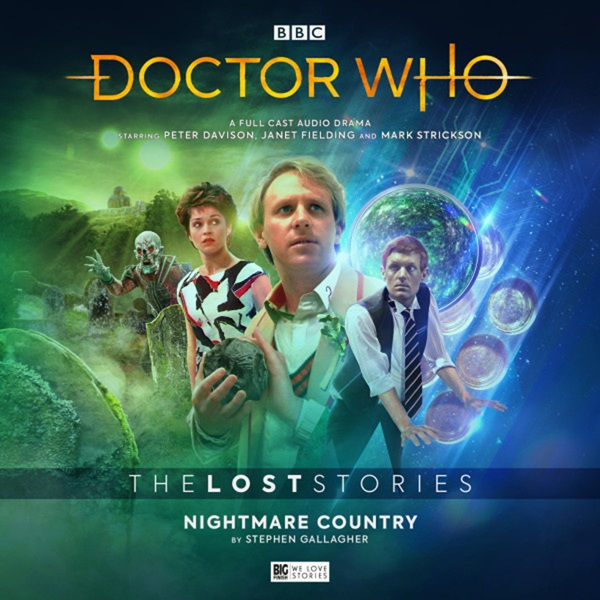
Then in 2008, Big Finish Productions began a new range of releases known as Doctor Who – The Lost Scripts. With Colin Baker’s era featuring at least a season’s worth of unproduced scripts, it was a natural enough place for Big Finish to start. With Bidmead’s serial having been mentioned in the aforementioned documentary, the company reached out to the writer about adapting the scripts for audio. It was then that the visual nature of the serial became apparent with Bidmead working with Big Finish producer/script editor David Richardson to create a new, audio friendly version. One that would go before microphones at the tail end of March 2009 and be become the fourth release of the range the following February.
How well did Bidmead and Big Finish transition a script deliberately tailored for television into an audio drama across two CDs?
Well, as Saward himself noted to Bidmead in 2019’s The Writer’s Room featurette on the Trial blu-ray, The Hollows of Time was a visually ambitious story. Something that, in making the transition to audio, ultimately let it down. Whereas other unmade serials could use the tricks of the audio drama trade that Big Finish had made so much use of over the years such as suggestive dialogue and sound design, Bidmead turned to the oldest of cliches: narration and outright describing things in dialogue. The serial’s big cliffhanger, featuring the Doctor trapped in a car flung down a time tunnel as it begins to come apart, plays out with either the Time Lord talking to himself or two other characters watching events and describing it to each other. The result might have made for a visual spectacle at the hands of the right 1980s BBC special effects team but, on audio, becomes a tedious experience.
This feeling isn’t helped by Bidmead having turned to a brand new framing device introduced for the adaptation, the Doctor and Peri discussing events in TARDIS after the adventure and largely presenting the serial in flashback. The story involves their traveling to meet the Doctor’s old Bletchley Park colleague Reverend Foxwell in the quaint English village of Hollowdean; a village where a cult led by another reputed wartime colleague, Professor Stream (known to his followers as the “All-Flowing Professor Stream”) has set up, funding some of Foxwell’s experiments in AI technology. There’s the young boy Simon who claims to have seen “sand creatures” and, eventually, the discovery that Stream is not all that he seems and that Simon’s creatures are in fact the Tractators. But any sense of tension where the Doctor and Peri are involved (including the over-described episode one cliffhanger) is deflated by the presence of the framing narrative. Indeed, it brings to mind the interruptions in narrative flow caused by the trial scenes in The Trial of a Time Lord, with Bidmead’s efforts here are just as annoying and damaging to the overall production.
Nor is this the only sin of the new framing scenes. Combined with leaps in the narrative timeline that Bidmead employed via it, the framing device serves to chop up a plot that might already have been overstuffed. Plot elements like Stream’s cult are introduced and quickly discarded and the Tractators (arguably one of 1980s Doctor Who’s better monsters) are reduced to being silent plot points without a will or even a voice of their own. It’s something that leaves the listener feeling that this is a serial with paradoxically too much and too little happening at any one time.
That The Hollows of Time was recorded and released when it was added another complication for Big Finish. As fans of 1980s Doctor Who and anagrams in general might have realized, Stream wasn’t just a random villain. Instead, he was fully intended to the Anthony Ainley incarnation of the Master making what was by 1985 essentially an annual appearance in the series. When the audio version was recorded in 2009, however, Big Finish faced two problems. One was that Ainley had passed away earlier in the decade (having spurned the chance to work with Big Finish over contractual issues), thought this was a problem that could have been easily solved by recasting. The bigger problem was that the Master was about to make a return in the TV show for David Tennant’s epic initial exit from the role in The End of Time. As such, the production office in Cardiff decreed that the character could not appear in Big Finish’s audio dramas for some time, even if the script was originally written a quarter-century before.
The solution? Use the frame device and a bit of casting to broadly hint but not actually reveal. Something which, along with the wider use of the framing device, became rather tedious as the Doctor and Peri returned time and again to the question of ‘Who was Stream?’ only to end with an anti-climax in the final scene as the Doctor changes the subject. Something which is a shame as actor David Garfield (himself no stranger to Doctor Who having appeared as the villainous alien War Lord von Weich in 1969’s The War Games and the Sevateem shaman Neeva six years later in The Face of Evil) offered a solid performance which, both owing to the writing and Garfield’s vocal qualities, more than hinted at Ainley. It’s tempting to wonder what might have happened if The Hollows of Time had been held off until a later Lost Stories season when it would have been less of an issue instead of playing a frustrating game of “is he or isn’t he?” for two hours to the detriment of the narrative and the annoyance of all but the most generous of listeners.
Of all the Lost Stories releases from Big Finish, The Hollows of Time is perhaps the hardest to judge in terms of what its 1986 TV counterpart might have been. Something owed in part to the heavy handed changes Bidmead made in a bid to bring his exceedingly visual television script to life in the audio medium. Further handicapped by an overly intrusive framing device and having to dodge revealing its villain’s identity, the Big Finish adaptation of Bidmead’s unmade serial can not be called either a faithful adaptation nor a functional audio drama in its own right.
Instead, it occupies a no man’s land between the two without offering a version of what Doctor Who fans might have seen on BBC one in the spring of 1986.
Matthew Kresal is, among other things, the author of the SLP book Our Man on the Hill and short stories in the anthologies AlloAmericana, The Emerald Isles, and The Scottish Anthology.

Comments