
Review: Unholy Land
By Charles E.P. Murphy

In the early 1900s, a Zionist expedition came back from a fact-finding mission to British East Africa – and recommended taking up London on its offer to settle a Jewish homeland there instead of the Middle East. Generations later, there's a vast modern Jewish-majority nation between Lake Victoria and Mount Elgon, and there's also an unending conflict with the displaced Nandi people. Minor writer Lior Tirosh left for Berlin years ago but now he's back to see his dying father. Coming back from "outside" puts him on the radar of the unassuming, oh-so-reasonable, and casually violent security officer Bloom, and also on the radar of a rival intelligence group, and also on the radar of a faction carrying out a series of strange murders.
Tirosh writes crime stories but he isn't ready to get involved in this sort of world for real. However, he's also a sci-fi writer and so he might be ready to accept one part of this shadow war: that there's a multiverse of alternate timelines out there, and some of them are bleeding into his...
"The Jewish state was made in East Africa instead of Mandatory Palestine" is on its own a big premise for an alternate history, and Lavie Tidhar really goes for it. Precise events in the timeline are quietly doled out to us as we go but from the start the country feels a very lived in place. It's a bit like Israel but is also its own beast with its own climate, its own architectural developments, its own old colonial buildings and holdovers from the British Judea days, its own super-wealthy posh people in lakefront condos, its own street music combining African influences with Jewish traditions and Europop. Even the language is different, Judean, a language we get translated for us but we later hear a speaker get confused by Hebrew as it sounds like an 'archaic' Judean to them. Lions, hyenas, and giraffes still roam near some of the farmland (and in others, were hunted down). Tidhar spent time in East Africa and loved it, and this comes through.
The ongoing low-level war (and references to past wars with Uganda and the Mau Mau) are, of course, a translation of Israel and Palestine to Africa. Unholy Land cynically says that the names may change but things remain the same. When Tirosh goes through the airport, he sees African dignitaries arriving for a peace summit which nobody expects to lead to anything. A brutal army raid in the Disputed Territories is the same as brutal raids in the West Bank. In one scene, after a suicide bombing, three people discuss the need to crack down on the Nandi, you can’t trust those people, but at the same time, you have to let some in, who'll do the low-paid work otherwise?
Alas, the book was written in 2018 and translating 2010s Israel & Palestine to East Africa, so what was grim and cynical, including that suicide bombing and that brutal raid, is not as bad as the atrocities we've seen since 2023. The book would be a quite different story now if it had to translate concerts & border towns being butchered and a state responding with deliberate destruction of cities, mass starvation as a weapon, and other horrors. Similarly, there's what was a clever barbed gag in 2018 in this Jewish homeland being called Palestina and the proud nationalists being Palestinians, but a book in 2026 couldn't do that for the connotations would be quite different now. It's not Unholy Land's fault, it's only a book, but it does hang over it in parts.
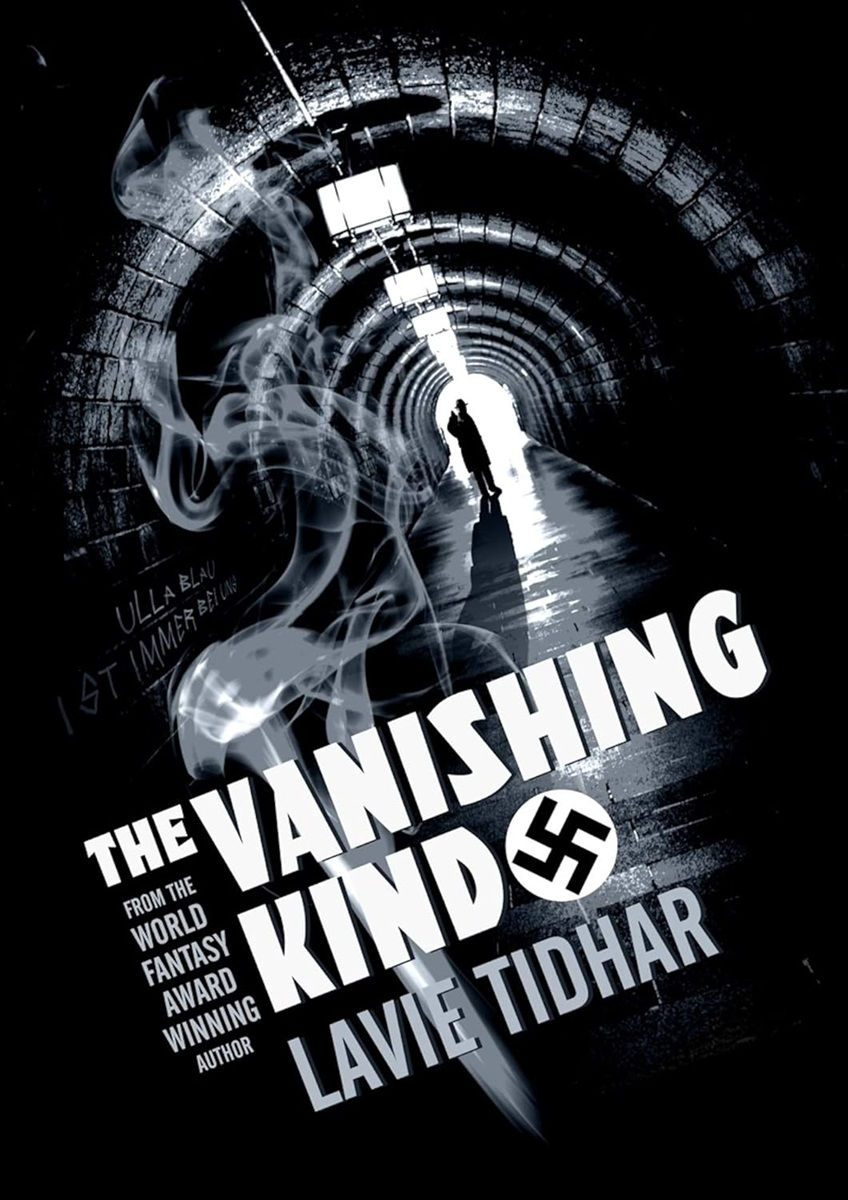
As a book, this is a very good low level spy thriller in the dark side of a Jewish Africa. Just doing that would be good enough for most writers but it isn't enough for Tidhar. We're also getting some reality warping multiverse sci-fi going on around it, with the glittering white city with airships on the cover being a city but not the one Tirosh is from; and a lot of drama in Tirosh's experiences as a returning expat, in his desperate need to forget some painful memories from a recent bereavement, and in how he both holds fast to the power of stories (and he's correct, the multiverse is framed by those in the know as a battle of narratives) and is pretty sure his stories are pap.
Some of this is part of Tidhar's fourth pillar: metafiction that kicks down the fourth wall. You've probably noticed in this review that L.T. the expat author who does sci-fi and crime stories is writing about L.T. the expat author who does sci-fi and crime stories – Tirosh has even written a book that Tidhar did in real life! This is a fascinating bit of quasi-autobiography, looking at the nature of being a jobbing genre writer & being a writer whose books straddle the pulp/literary divide in a messy way and the nature of being an expat and especially an expat from a country with conflict. An uncomfortable moment has one of Tishor's old school friends telling him he doesn't really care as much about politics as he thinks because he left instead of sticking around. Several times when Tirosh is considering himself or someone else is commenting on him, you want to give Tidhar a hug.
Another nice trick of the metafiction is that early on, it turns out we're not reading a third-person prose story – we're reading a first-person prose story by Bloom, telling us what this guy Tirosh was up to during Bloom's hard-but-necessary heroic adventures of brutalising civilians and executing enemy agents. You get some distance from Tirosh's angst but you're right in Bloom's head as he deliberately traumatises a Nandi child, but he has to, you see, to protect his people, he doesn't hate the Nandi he's hurting but they're in the way. (As noted above, this is something it'd be harder to do after 2023. It's already dark seeing in Bloom’s head but post-2023 it would be black as pitch)
Everything in the book is anchored by Tirosh being, at heart, just some guy. He's not particularly brave, smart, or important, and everything going on is confusing and dangerous. In the afterword, Tidhar says most people are like Tirosh. The book reminds me a lot of Philip K. Dick (an influence on Tidhar, with his Martian Sands having a Mars modelled on Dick's Martian Time Slip) in this way, a book about weird and trippy things but all of it happening to normal, unimportant sad-sack humans trying their best. Palestina has a long history spawned from 1900s political dreaming, but the people just live there.
Grim events may have dated it already, but it remains a trippy thriller that cares about the little guy.
Charles EP Murphy is an author who, among other works, wrote the books Chamberlain Resigns, and other things that did not happen and Comics of Infinite Earths for Sea Lion.

Comments