
Tales From Development Hell: Bogart Slept Here
By Ryan Fleming.

The right role can make or break an actor’s career. Often too we hear about the roles an actor may have missed out on that they regret. If a missed role can carry a pang of regret, can the opposite hold true? Can an actor missing out on a role they were all lined up for in fact be a benefit? Not so much in the sense of dodging a bullet by not appearing in a poorly received film, though there are plenty of examples for that, but an instance where a successful, talented actor is cast in what would be an overall well-made film but is just wrong enough that both film and actor suffer?
Bogart Slept Here might be one such example.
A late 1970s comedy starring Robert De Niro, directed by Mike Nichols, and scripted by Neil Simon sounds on paper like a winning combination. Those were the main personalities involved with Bogart Slept Here, a film that was ultimately never made.
It is Nichols that gave the idea that would become Bogart Slept Here its inception. Hired to direct The Graduate (1967) whilst a relative unknown in Hollywood himself, he had taken a chance on a lead actor who had no prior film experience: Dustin Hoffman. The film went on to be a massive success, with many hailing Hoffman as the harbinger of a new generation of actors. The story went that when Hoffman received the phone call for his breakthrough role that he and his then-girlfriend exchanged a look that said they were both in trouble. A working New York theatre actor whisked off his feet to Hollywood where his first film role would launch him into an international film star, it was an interesting concept itself for fiction.
Nichols’s career continued its upward trajectory with Catch-22 (1970) and Carnal Knowledge (1971) but would take a downturn as the 1970s continued with pictures that were not well received or that successful. Films like The Day of the Dolphin (1973) and The Fortune (1975). Yet the idea for a film based on Hoffman’s rise to stardom was still being worked on by a frequent collaborator of Nichols, Neil Simon.
Throughout the 1960s, Simon had established himself as the most prominent Broadway playwright and a national celebrity. He had adapted his plays Barefoot in the Park (1963) and The Odd Couple (1965) into successful films in 1967 and 1968, respectively. Both of the original Broadway productions had been directed by Mike Nichols. Nichols would also direct Simon’s plays Plaza Suite (1968) and The Prisoner of Second Avenue (1971) on the stage. On the latter however their relationship began to sour. Simon was envious of Nichols receiving the lion’s share of the credit for directing his plays. Nichols was not in the best frame of mind either as the unkind reviews towards the like of the fortune took their toll on him.
Despite these difficulties, development on Bogart Slept Here continued apace. Simon’s developed idea for it was to focus on an ex-dancer married to a promising yet struggling Broadway actor who, after discovery and casting in a major Hollywood film, reluctantly moves to Hollywood with his wife and their children. The plot would have followed the strain that the fame puts on their relationship. Simon even had someone in mind for the female lead, his then-wife Marsha Mason.
It would be the male lead that would attract the most attention and ultimately prove the film’s undoing. Like Dustin Hoffman, Robert De Niro was representative of a new mould of lead actor that came with New Hollywood. His breakthrough role had come in The Godfather Part II (1974), portraying a younger version of the title character, Vito Corleone. His performance would land him an Academy Award for Best Supporting actor in 1975. He had already begun what would prove to be a long-running collaboration with Martin Scorsese on Mean Streets (1973). On the set of that film one crew member recalled that whilst De Niro and Harvey Keitel were given some leeway to improvise, De Niro was extremely involved in his role and preparation, becoming isolated from his fellow cast members. He would bring this method acting to his next collaboration with Martin Scorsese, Taxi Driver (1976). De Niro would lose 30lbs, adopt a Midwestern accent, speak with Vietnam veterans, and even work as a taxi driver to play that film’s crazed title character. He was also filming Bernardo Bertolucci’s 1900 (1976) in Italy at the same time as preparing for Taxi Driver, flying back and forth between Rome for filming and New York City to drive a taxi.
A mere three days after shooting wrapped on Taxi Driver, an intense, violent drama about the rotten core of the Big Apple, De Niro wandered onto the set of Nichols and Simon’s romantic comedy Bogart Slept Here. It might be jarring for anyone to go from such serious, dark subject matter to something more light-hearted and comedic. It quickly became apparent to both Nichols and Simon that something just wasn’t clicking on Bogart Slept Here.
De Niro later recalled that he was inexperienced in the particular kind of comedy that Simon wrote, was off with his timings, and felt unenthused about the whole thing. Simon’s recollection was that De Niro is not an unfunny actor but it is mostly from nuances that were at odds with the script’s sensibilities. Simon believed that his humour would be lost in the performance. Nichols, his confidence already shaken from the mixed reception to his most recent films, was very upset with how things were turning out. He refused De Niro’s offer to put up his salary against another week of rehearsals, and after Warner Bros. were likewise unenthused by what footage had already been captured, they fired De Niro.
It was a bold move to fire an Academy Award winning actor from such a prominent film. The press went into rumour overdrive about onset conflict, and whilst there was some bitterness as to how the situation turned out, this was overblown. Raul Julia and Richard Dreyfuss were both auditioned to take over the lead role, but Nichols did not feel either actor was right and eventually Bogart Slept Here was cancelled outright. Nichols would not direct another dramatic feature film for almost a decade.
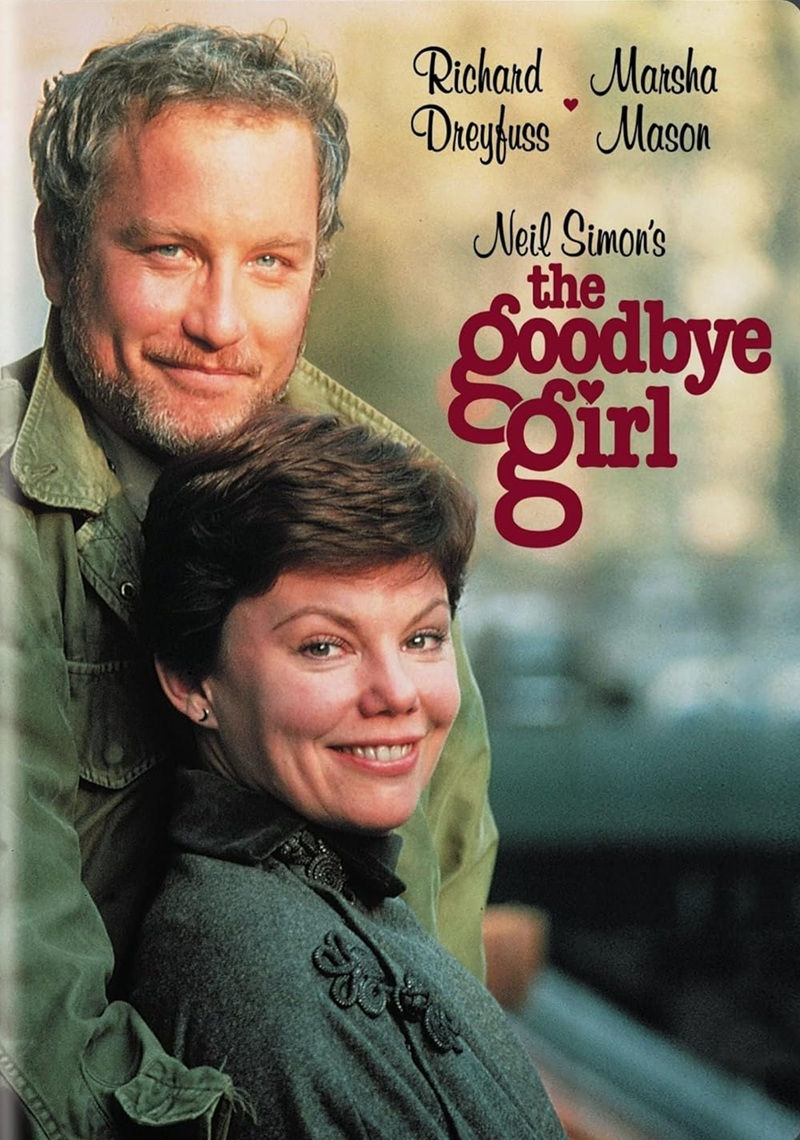
There was one person who still had belief in the concept: Neil Simon. He had seen something in the chemistry when Dreyfuss had auditioned with Marsha Mason. However, Simon still did not believe that the script could get the best out of both actors, so sought to rewrite it. After six weeks, he had completely overhauled the film and turned in a new script. The focus was shifted away from the original concept based on Dustin Hoffman’s rise to stardom and instead focused on the meeting between an off-Broadway actor (Dreyfuss) and an ex-dancer (Mason) raising her daughter (Quinn Cummings) alone. That the new script focused on the meeting and initial bickering between two people accidentally thrown together necessitated a change in title. Bogart Slept Here thus became The Goodbye Girl (1977). The reworked film would prove a massive success, becoming the first romantic comedy to gross more than USD 100 million at the box office. It would also earn numerous accolades, particularly for Dreyfuss who would win the Academy Award for Best Actor for his performance. Cummings, Mason, and Simon would all be nominated too for Best Supporting Actress, Best Actress, and Best Screenplay; with the film itself even earning a nomination for Best Picture.
Whilst Nichols took a hiatus from film and Simon reworked Bogart Slept Here, Robert De Niro went straight to his next role. That was the title role in Elia Kazan’s The Last Tycoon (1976), a film that would otherwise have had to be put on hold whilst De Niro worked on the Nichols/Simon picture, much to the ire of director Kazan. His continued drama work would also earn the Academy Award for Best Actor for his performance in Martin Scorsese’s Raging Bull (1980). He would not remain estranged from comedy forever. Starting with Scorsese’s romantic comedy musical New York, New York (1977), and then on The King of Comedy (1983), itself offering many similar beats to Taxi Driver but as a dark, satirical comedy. By the turn of the century, De Niro would star in many comedy pictures, most playing off the sort of roles he would play in drama. This was to acclaim in the likes of Analyze This (1999) and Meet the Parents (2000) but would also be met with criticism for appearing in films such as The Adventures of Rocky and Bullwinkle (2000), though even that slapstick comedy film aimed at children saw him reference his prior work in Taxi Driver.
What if Nichols had been willing to stick it out with De Niro on Bogart Slept Here? What would the finished film have looked like and how might it have impacted both men’s careers?
It might seem a simple prospect – have Nicholls agree to De Niro’s terms for another week of rehearsals, giving the actor time to find his feet – but it is a difficult one to envision transpiring. For one, the offer was there on the table historically with little to be lost from Nicholls’ perspective, but it was turned down. Neil Simon even offered to rework the script, as he would later do for Dreyfuss, but Nicholls also likewise refused this offer. The reason for the cancellation was perhaps as much a lack of confidence on the part of Nicholls as it was De Niro’s ill-suiting to the script.
The simplest, and bluntest, way for production on Bogart Slept Here might be for Warner Bros. to refuse Nicholls request to fire De Niro and instead insist they find a way to make it work, keen to have the bankability of De Niro’s name above the marquee. Any production continuing under those circumstances would likely not be a happy one. The end result of that might be the eventual firing of Nicholls from the production, maybe to be replaced by Herbert Ross, who had already directed The Sunshine Boys (1975) adapted from Simon’s play of the same name and would go on to direct The Goodbye Girl. Under these circumstances, it is exceptionally likely that Nicholls still takes a prolonged hiatus from making dramatic feature films. It might even last longer, and a permanent one is not outside the realms of possibility, returning exclusively to theatre work.
As to De Niro, even if Simon does make some changes to the script, his lack of enthusiasm combined with an unhappy director might be readily apparent on screen. Couple this with the press playing up problems on-set as they did historically when news of De Niro’s firing became known. One alleged quote from Nicholls manufactured at the time was that De Niro was “undirectable”. This is undeniably the work of tabloid exaggeration, but with the director fired, the screenwriter making changes daily, and an unenthused, ill-fitting performance on screen that might become the real story of Bogart Slept Here. If his next film is still Kazan’s Last Tycoon, already not receiving great reviews historically, then some of the shine might come off De Niro in the eyes of Hollywood. He would almost certainly recover, for one thing his relationship with Scorsese was unlike many others in the history of director/actor collaborations, but his winning of Best Actor might not come when it did historically for Raging Bull, even if that performance and film remain exactly the same. However, after his experiences on Bogart Slept Here, comedic roles might be forever something that De Niro is hesitant about taking.
What of the true beneficiary of De Niro’s firing from Bogart Slept Here? His Best Actor win for The Goodbye Girl made Richard Dreyfuss the youngest actor to win that award (at age 30) until Adrien Brody would beat it by one month for The Pianist (2002). Without that win, the record would remain with Marlon Brando for On the Waterfront (1954), also by Kazan and a film whose own development hell has been covered in this series. It is also far less certain that Dreyfuss would ever win the Award compared with De Niro. There seems to be marked change in the films he appeared in before The Goodbye Girl – like American Graffiti (1973), Jaws (1975), and Close Encounters of the Third Kind (1977) – and those that he began appearing in afterwards like The Big Fix (1978) and The Competition (1980). It is possible, but by no means certain, that without The Goodbye Girl that he continues acting in the sort of films made by George Lucas or Stephen Spielberg, which might bring far more box office royalties but would bring far fewer accolades from awards ceremonies. He would at least probably still have the good sense to avoid appearing in any Jaws sequels, even if producers are more likely to approach him as an actor associated with big budget pictures.
Bogart Slept Here impacted its fair share of careers despite being cancelled, had the unhappy production continued it might have impacted several more. Anyone who was a beneficiary from The Goodbye Girl might not be from Bogart Slept Here.
Firing a recent Academy Award winner from a film, as well as cancelling outright a film after it has begun filming, were rarities in Hollywood in the 1970s. Both things happened to Bogart Slept Here. A film that had its genesis in Dustin Hoffman finding stardom, its replacement wound up making the career of Richard Dreyfuss as a leading man, whilst its cancellation perhaps saved Robert De Niro’s career from a stutter step following his original rise to fame. For a film that was never completed Bogart Slept Here was a cross-section of the Hollywood of the era.
It also shows that sometimes even with the best actors of all time that not all roles are right for them, and trying to do too much too quickly can only make that situation worse.
Ryan Fleming is the author of SLP's Reid in Braid and various short stories for the anthologies, as well as editing The Scottish Anthology.


Comments