
Dreams From The Dark Years: Mers-el-Kébir
Updated: 6 days ago
By Paul Hynes.

The 3rd of July 1940 had been intended to be a pleasant day for the sailors of Force de Raid (Raiding Force). Based at Mers-el-Kébir harbour beside Oran on the coast of Algeria, the squadron faced an uncertain fate. Following the armistices signed with the Axis powers their fellow sailors who lived in Algeria had already departed. Most of those who remained were keen to return home as well, the disruption caused by the German invasion that spring meant there had been little news from the metropole.
To combat these anxieties a sports day was planned followed by a night on the town in the bars of Oran. The commanders of the remaining sailors were worried about the morale of their men under their care more than anything.
The foreign ships which appeared on the horizon would soon become a much greater distress. They were soon broadcasting messages of friendship while laying mines around the harbour.
Tragedy
The attack perpetrated against Force de Raid that day would take the lives of 1297 French sailors. The best ships of the French fleet lay wrecked in a harbour which had become a vision of hell. Their heaviest guns facing the shore had made it difficult to defend themselves. The idyllic harbour front, meant to be a host for rowing and swimming competitions, was now littered with corpses and fire from burning oil spills. Men who had tried to swim to safety had found themselves trapped in the oil and were forced down over and over until they eventually lost the energy to fight.
Who could have perpetrated such a treacherous act against ships unable to defend themselves belonging to a nation at peace? Perhaps the Germans, or the Italians, or the Japanese?
The culprits were in fact Force H of the Royal Navy. The French sailors had been murdered by men who had been their allies barely a week ago.
The attack is generally known as the tragedy of Mers-el-Kébir in French historiography. It was the bloodiest episode of Operation Catapult, an effort across continents to deny use of the French navy to the Axis.
Force de Raid with its four modern battleships was of particular concern. By the end of the day three of those four would be incapacitated. The reactions were predictable, “utterly repugnant”, “sheer treachery”, and that was only from the perpetrators themselves. In France it would confirm the suspicions of those who had grown paranoid over British intentions following the military debacle in the Spring. Perhaps the British were the true enemy of France after all.
Why did so many French sailors have to die in an act hated by those who committed it? The answer lies in paranoia which had grown over both sides of the Channel which provoked the literal torpedoing of an alliance which had been nurtured over decades.
Brothers at Sea
Although British and French politicians had often been at odds and respective army figures had viewed each other with mutual suspicion, the relationship between the Royal Navy and Marine Nationale had only grown stronger in the years leading up to the Second World War. This had been guided on the French side by Admiral Francois Darlan. The political savvy of Darlan had helped him achieve a meteoric rise up the ranks of the French navy. He was also appreciated for being a competent administrator with enough ability and vision to ensure France had a modern and powerful fleet. Unlike General Gamelin, Darlan’s headquarters outside of Paris was bristling with telephones and telegraphs connected across French bases and ships alike. By 1939 only Japan, the UK and the US had stronger navies than France.
Darlan’s priority had been ensuring the Marine Nationale was more powerful than the German Kriegsmarine or the Italian Regia Marina. Ensuring both would be kept in check in any future war had required close cooperation with his British counterpart Admiral Dudley Pound. When war broke out Darlan and Pound were forced to deal with the adventurous plans of the returning British First Lord of the Admiralty, Winston Churchill, who had immediately begun drawing up plans for landings in Norway and raids into the Baltic.
For the first few months of the war the Anglo-French fleets were mostly focused on ensuring the Atlantic remained open to their shipping and cutting off access to Germany. German surface raiders and submarines were a source of major concern. Submarines were the more numerous threats, but surface raiders drew more attention as their heavy guns threatened to wipe out entire convoys if they were allowed to roam free.
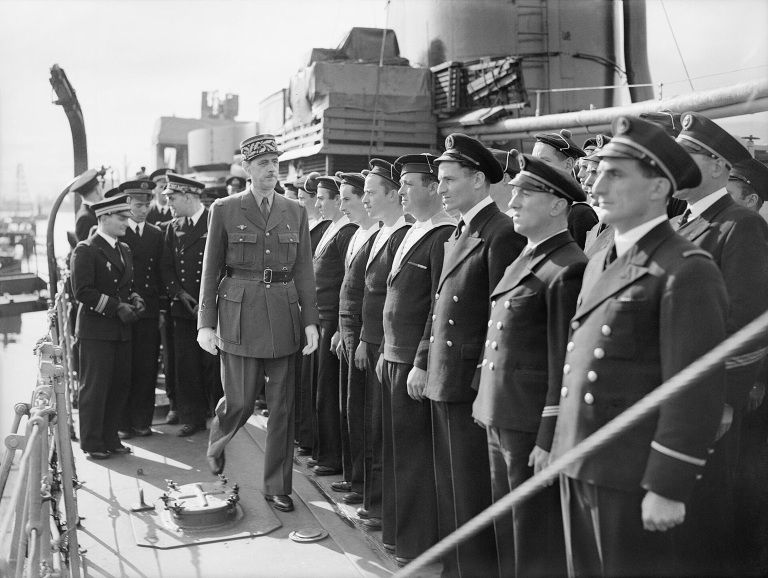
Darlan and Pound worked together to share resources. The French concentrated their most powerful modern ships into Force de Raid under Admiral Marcel-Bruno Gensoul. Captain Cedric Holland worked alongside Darlan as the Royal Navy’s representative at French Naval Headquarters. It was an example of the sort of integrated command structure which would later serve the British well with other allies.
An Anglo-French battle group led by the British aircraft carrier Hermes and French battleship Strasbourg patrolled the Central Atlantic operating from Dakar. The British battleship Hood and the French Dunkerque did the same in the North Atlantic. In December 1939 Force de Raid led a convoy of supply ships across the Atlantic. Captain Holland worked as Gensoul’s deputy for the successful operation with both parting on good terms expressing a wish to work together again soon.
Force de Raid had been moved from Mers-el-Kébir to Brest on the French Atlantic coast in preparation to assist in the defence of Norway in April but was moved back to the Mediterranean in the following month due to fears of imminent Italian entry into the war. Another French squadron, Force X, moved to the Eastern Med and based itself in the port of Alexandria in British occupied Egypt. Darlan blamed the British for encouraging Italian aggression, complaining they lacked an “offensive spirit” when it came to the Mediterranean after they poured cold water on his plans for pre-emptive strikes against the Italians.
Nonetheless when Holland was given the command of the British Aircraft Carrier HMS Ark Royal, he received a fond farewell from his French colleagues. One remarked that each of them felt like they were losing a personal friend.
Navigating the Debacle
The officers of the Marine Nationale watched the disaster unfold on land in May 1940. By the time the Germans reached the coast on the 20th and the French fleet could intervene more directly, the chances of salvaging the situation were rapidly diminishing. The breakdown in relations between the British and French now began to affect both navies. Darlan’s naval representative in the UK, Admiral Auphan, reported incorrectly that the British had decided to evacuate the British Expeditionary Force on the 20th. Thus, the head of the French navy had come to understand the British were keen to abandon the French as quickly as possible.
By this time evacuation of the pocket of Allied troops around the French side of the Channel had become unavoidable and the French were quick in coordinating evacuation efforts. British troops who were largely closer to the coast took priority for evacuation, which led to some bitterness amongst the French. When most British troops were evacuated the Royal Navy began to wind down their operation at Dunkirk rather than continue to assist French troops which only heightened suspicion.
As previous articles have mentioned, the British still had high hopes for Darlan. Even as mistrust deepened and French collapse became inevitable it was assumed Darlan was personally trustworthy and would not allow his ships to fall into the hands of the Germans. After all, he had already pledged he would sail the French fleet to London should France capitulate. Darlan had poured cold water on the feasibility of evacuating French troops to North Africa but he was keen to make sure the French fleet did not fall into their hands. As late as the 15th of June, the day before Pétain took power, he was preparing to move his ships to British ports.
Nonetheless by this point Darlan had no intention of fighting on in opposition to Pétain. He had come to the conclusion at some point in May or June that Britain would not be able to fight on alone, possibly due to this understanding of events at Dunkirk. Darlan joined Pétain’s cabinet as Naval Minister, satisfied that any German demands for the fleet in armistice negotiations would be rejected. The Germans were happy to oblige this.
Professor Karine Varley notes how the German armistice terms for the French fleet left the British and French at an impasse. The British had accepted France might need to seek a separate peace but only on the condition French ships should be left out of reach of the Axis powers. The French agreed and so too it seemed did the Germans however the armistice required French ships to return to their home ports which for the strongest French units meant Brest, inside the German occupation zone. It seemed the Germans would be able to grab these ships anytime they wanted.
Catapult
Despite Darlan’s predictions, the British government was resolved to fight on. The fall of France had been a catastrophe but there was little to be gained in dealing with Hitler. There were some reasons for optimism which Charles de Gaulle had also calculated, the Royal Navy still controlled the seas assuring the UK could get everything it needed from the USA and elsewhere while Germany and Italy couldn’t. The shock of the French defeat was increasing support for intervention within the United States and there were already signs the Non-Aggression Pact between Germany and the Soviet Union might not last long. All the UK needed to do in the short-term was not lose and in the long-term victory would be possible.
Although the Battle of Britain is now largely remembered as an aerial battle between the Luftwaffe and RAF, the naval component was just as important. Even if Germany had been able to achieve air superiority over Southern England, they couldn’t hope to blockade the UK or invade without incurring the wrath of the Royal Navy. The Kriegsmarine had started off the war heavily outnumbered by their British opponents and had lost a third of their surface fleet during the Norwegian campaign. The Italian fleet was more formidable but for as long as the UK controlled Gibraltar and the Suez Canal it would be a threat confined to the Med.
The Marine Nationale threatened to make all the difference. If the Germans were able to seize control of the French fleet their strength in the Atlantic would have more than doubled. They could have caused chaos in Atlantic shipping lanes or flanked invasion convoys crossing the English Channel.
It was these nightmare visions which led to Operation Catapult.
It is not clear when exactly Catapult was first planned. It might have been prior to the French surrender but by the end of June the British war cabinet had agreed the French fleet would need to be neutralised one way or the other. This was ignoring the conclusions drawn by British intelligence which stated the French could be relied upon to keep their ships out of Axis hands.
The three main targets were French ships in British ports, the French squadron in the Egyptian port of Alexandria, and Force de Raid at Mers-el-Kébir. The new French government was in transit now Bordeaux was in the German zone of occupation, effectively cut off from communication with London. Because of this the British were unaware that the Axis powers had already agreed French ships could be demobilised in ports outside of their occupation zones and that Darlan was already making preparations for his ships to be scuttled should they break their word.
Ultimatum
The seizure of French ships in British ports led to one violent encounter. On the French submarine Surcouf, French sailors and British Royal Marines exchanged shots following the French refusal to disarm. Three Marines and one French sailor died in what was one of the few exchanges of fire between armies on British soil during the war.
In Alexandria the day was spent in occasionally tense but largely cordial negotiations. The British Admiral Cunningham and the French Admiral Godfroy had a good personal relationship and managed to reach an agreement where the French squadron would remain in the port disarmed under Godfroy’s control.
It had been hoped the previous relationship between Admiral Gensoul and Captain Holland might achieve a similar peaceful outcome at Mers-el-Kébir. The ships of the British Force H which had been created to replace Force de Raid in the defence of the Western Med were an imposing sight. They included Holland’s Ark Royal and its flagship the HMS Hood, one of the most formidable and famous battleships in the world.
From the Hood the commander of Force H, Admiral James Somerville, broadcast the ultimatum he had been reluctantly sent to deliver. After briefly praising their past alliance and the French ships Somerville stated the British intent to fight on to victory and their unwillingness to allow the Axis to use the French fleet. He then gave the squadron the following options:
Fight alongside the Royal Navy until victory.
Sail with reduced crews to British ports where their ships would be interned.
Sail to a French port in the Caribbean such as Martinique and disarm themselves there, perhaps under the protection of the United States.
The ultimatum bluntly stated that if none of these options had been agreed to within six hours, Somerville would require the French ships be sunk.
Gensoul was unfazed. He stated he would never turn his ships over to the Axis but would not break with the orders given to him by his superiors. Furthermore, he refused to talk to Holland, declaring that it would be insulting for an Admiral to negotiate with a Captain. The appeal to personal friendships had backfired.
Frantic negotiations were under way in Alexandria but at Mers-el-Kébir they had barely started by the afternoon. Gensoul had communicated the ultimatum to the French government but the dispersed nature of the French state during the time had made a response difficult. Darlan had been at home. Gensoul omitted the option of sailing to the Caribbean from his communication of the ultimatum, likely the most acceptable to the new French regime. He was told not to yield as reinforcements were on their way and to defend himself if attacked.
Gensoul did just that and he began to prepare the harbour for defence. When Somerville got word of this, he gave the order to attack.
Fratricide

Had they met on the open ocean Force de Raid would have had a good chance of seeing off Force H, but their largest ships were bottled into the harbour with their main guns facing toward the coast. It quickly became a massacre with naval gunfire from the Hood and other ships bombarding the harbour. Meanwhile torpedo bombers took off from the Ark Royal and began dive bombing.
Within ten minutes of the British attack, the French battleship Bretagne had shells detonate its ammunition magazine. Most of the crew were killed with the survivors being thrown into the burning waters around the wreck. The French sailors were not entirely helpless, coastal batteries returned fire as did the battleships Dunkirk and Provence. Both were so badly damaged they had to run aground to avoid sinking.
After ten minutes the entire harbour was covered in fire. Communicating over signals Gensoul and Somerville agreed a ceasefire. Somerville warned he would open fire again if he didn’t see the French sinking their ships by themselves but in reality he could see very little. The harbour was engulfed in black smoke.
Covered by the smokescreen was the Strasbourg, the final battleship. Navigating its way out of the mined waters it reached the open sea and made a run for it. Leading a group of five destroyers it sped off. The Ark Royal’s planes weren’t far behind but their bombs and torpedoes missed their target.
Strasbourg’s escape spared Mers-el-Kébir further bloodshed. The battleship was the biggest remaining prize and Somervile ordered his squadron to give chase. Somerville gave up two hours later upon receiving reports that Strasbourg had linked up with reinforcements. The attack had barely lasted thirty minutes but it had undone a friendship of more than thirty years.
Requiem
The attack provoked outrage in France. The funeral of the dead sailors, overseen by Gensoul, became a major propaganda event. These men would become martyred victims of British aggression. The British had been reacting to a fear of French ships becoming their downfall, now the new French regime reflected it back. The notion of a vast British conspiracy to control France or destroy which had previously only existed on the fringes of French fascists now became the official understanding. Diplomatic relations were severed and from now on any contact between London and the new regime in Vichy had to be informal. The French officially retaliated by bombing Gibraltar a few weeks later.
They were able to do so due to the German reaction to these events. The Wehrmacht had eased armistice restrictions on what was left of the Armee de l’Air and freed the fleet of their obligations entirely. This was in the hope the Strasbourg and other surviving ships, now based in Toulon in the French unoccupied zone, might be keen to settle the score. Occasional threats related to this would be made but never materialised. Nonetheless a powerful battle group of ships remained at Toulon and Force H would spend more than two years reckoning with the fact they might come looking for revenge at any moment.
The Italians were less enthusiastic than the Germans. They had wanted those ships for themselves and were suspicious of any activity which might bring France and Germany closer. The Italian foreign minister, Galeazzo Ciano, noted in his diary the British had shown a ruthlessness which clearly showed their willingness to fight on. He noted the Chief of Staff of the Regia Marina had been left unsettled.
It has been argued this demonstration of British resolve also impressed President Roosevelt across the Atlantic although historian George Melton points out if this was the case it wasn’t intended. Certainly there was relief that the ships which might threaten the USA were now lesser in number. When the new French ambassador to the United States attempted to elicit sympathy from Roosevelt over the British attack, the President responded he would have done the same thing in those circumstances.
In Britain the operation was presented as a regrettable but necessary evil and a decisive victory. Churchill declared the French fleet had been neutralised to acclaim in the House of Commons even while quietly seeking to reassure Darlan that no action would be taken against his forces in Toulon if they remained there. At the end of July, even before the aerial battle had reached its peak, Churchill had concluded there was no real invasion threat. At the start of August the British felt secure enough to start dispatching equipment and troops to Egypt.
There was some German planning for an invasion of Southern England as a last resort should the UK keep fighting, the name of the operation is forever lost to history. The limitations of the Kriegsmarine made it difficult to work out how a successful landing could be achieved let alone supplying it after, however in keeping with the armistice there was no plan to use the French fleet. By mid-September the RAF were grinding down the Luftwaffe in the skies and bombing the Kriegsmarine in French ports. The invasion was postponed indefinitely.
The Germans made one last half-hearted attempt at a surface raid into the Atlantic in May 1941 led by the battleship Bismarck. In confronting the Bismarck, the Hood met the same fate as the Bretagne with an even larger death toll. A day later torpedo bombers from the Ark Royal disabled the German battleship and it was ultimately sunk in a torrent of shells from British ships. The Germans still had major surface units in the English Channel despite increasingly heavy RAF raids until they escaped all at once during the so-called Channel Dash of February 1942. Any remaining threat to the British Isles, if there had ever been one, was now gone and soon the British and their new American allies began planning their own Channel crossing.
The Strasbourg remained in Toulon where it was eventually joined by Dunkirk and Provence. A lack of materials made repairs on both ships take time. They weren’t complete in November 1942 when the Germans occupied Southern France. When the Germans attempted to seize them the three battleships were scuttled alongside more than a hundred others.
Victim Blaming?
In the Anglosphere there is a tendency to depict the attack on Mers-el-Kébir as a necessary evil. It is a line which hasn’t changed much since the statements made in the wake of the attack. Alongside these laments there is occasionally praise for the ruthlessness of the action, similar to Ciano’s remarks.
After the war Churchill compared himself to Robespierre. In slaying the French fleet, he had thrown a gauntlet to the Fascist world just as the French revolutionary had done to the old aristocracies by slaying the French monarch. The difference of course being he hadn’t killed a tyrannical despot but over a thousand ordinary sailors who had been his allies a week beforehand.
Blame is often pointed at Darlan or Gensoul for failing to comply with British demands. Both certainly could have done more to prioritise the safety of the men under their care but they were not the ones who planned and then executed the attack. Darlan, as we shall see in later articles, eventually found his way back into Allied favour. However, Gensoul died without ever expressing any regret for his actions. At a postwar trial, charges of Gensoul endangering the fleet were discussed and ultimately dismissed. Both are sometimes compared negatively to Godfroy’s actions at Alexandria but it should be remembered Force X was trapped in the port, and attempting to run for it like Darlan ordered them to do would have been suicide. Godfroy might well have acted differently had been responsible for the most powerful French ships in a French controlled harbour.
The events at Toulon at the end of 1942 confirmed British suspicions the Axis would try to seize French ships but also confirmed that the French would sink them if they tried. The basic logic behind Catapult had been flawed and the failure of the operation to neutralise the French fleet threatened to create a powerful enemy.
Had Hitler been more receptive to French appeals for aid in striking the UK in Africa and Asia, the Allies might have found themselves with several more fronts to deal with. The British dispatched forces to Egypt in August but they were also required to send them to Senegal where it was rumoured the French were preparing to hand over the port of Dakar to German submarines. Luckily the German dictator was even less trusting of his co-belligerents than Churchill was.
Avoiding Mers-el-Kébir would have cost very little for the British. More ships waiting out the war in Toulon was not the existential threat it might have seemed at the end of June 1940. The historian and publican Al Murray recently compared battleships to nuclear weapons of the interwar era, such was their power and prestige. However, as the war went on at sea it became increasingly clear the era of battleships was coming to an end and the aircraft carrier was in the ascendancy. France in 1940 only had one aircraft carrier and it was already in the Caribbean.
N'oubliez pas Oran!

It is likely the attack on Mers-el-Kébir was a pointless massacre. It failed to secure the best ships of the French fleet for the Allied cause or wholly incapacitate them. The powerful fleet which remained was now an enemy rather than a friend. Any propaganda victory regarding ruthlessness or impressing the Americans appears to be largely ephemeral.
That does not make it meaningless. It was a watershed moment for individuals and nations alike. It represented the breakdown of the Anglo-French entente and perhaps the most heightened expression of Britain’s crisis after the fall of France. It left the UK in the reality that for over two years to come they would be fighting against more Frenchmen than they had alongside them.
For the French in dealing with their own collapse it was a bitter betrayal. It briefly heightened Anglophobia to a fever pitch and set the course not only for a reactionary dictatorship but one which would find itself comfortably in the Axis camp. For the politicians who would craft the Vichy state, Mers-el-Kébir was the Reichstag Fire.
The next article will examine how that regime rose from right-wing leagues, Great War heroes and republican political animals. How it promised national redemption and a return to French glory from the ashes of the republic, from the flames of French defeat and British betrayal.
Paul Hynes is the author of the Decisive Darkness series and the Red Fuhrer series.

Comments