
Review: Doctor Who: The Guardians of Prophecy
By Matthew Kresal.

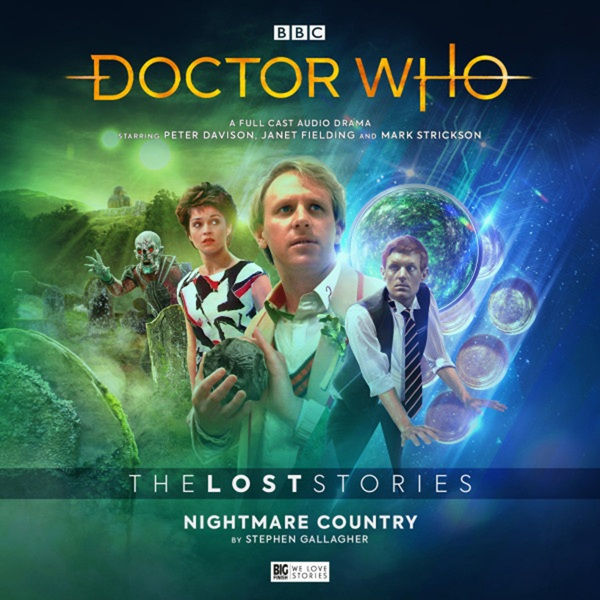
In reviewing the various Big Finish Lost Stories featuring Colin Baker’s Doctor, it has often been the case that they weren’t made because of the series being placed on hiatus in 1985. That wasn’t what sealed the fate for all of them, however. Other factors could come into play even for established writers for the series, as was the case with Johnny Byrne’s The Guardians of Prophecy, which took until 2012 to be appear on audio with two of its original stars.
By the time Byrne pitched The Guardians of Prophecy in the summer of 1983, he had not one but three Doctor Who serials to his credit. A writer since the 1960s when he moved from Ireland, Byrne’s career had also seen him work on series as wide-ranging as Gerry Anderson’s Space: 1999 and All Creatures Great and Small, the latter being where he came to the attention of future Who producer John Nathan-Turner. After turning down Nathan-Turner’s offer to become Who’s script editor, Byrne agreed to write for the series, crafting what became Tom Baker’s penultimate serial The Keeper of Traken. The success of Traken, lead to two further commissions during Peter Davison’s time in the TARDIS. With the success of The Keeper of Traken still in mind and the costume for its statue-like Melkur still in storage, a follow-up of sorts appeared on the cards while Byrne’s script for Warriors of the Deep was in production.
Aware that Traken had been destroyed as part of the events of Tom Baker’s swansong Logopolis, Byrne conceived The Place Of Serenity as being set on another planet, Serenity, that was part of the Benign Union formed in Traken’s wake. Ruled by an aristocratic elite known as the Elect and the computer known as Prophecy (itself a machine version of the Keeper from the Traken serial) a millenium later, there’s the threat of revolution brewing in the air. As the Doctor and Peri (played by Nicola Bryant) arrive, the famed thief Ebbko has been hired to break into the vaults of the Elect by their court recorder Auga to sabotage Prophecy. Doing so sees them infiltrating the tomb of the legendary Malador, creator of the Melkur. Only they and Peri discover that Malador is far from dead as revolution erupts, the Melkur stir into life, and the fate of Serenity hangs in the balance.
It was a promising story, one that built on the rich worldbuilding that Byrne had put into the original Traken serial. Unfortunately, Warriors of the Deep had become a troubled affair, undergoing numerous rewrites at the insistence of script editor Eric Saward (himself acting at the behest of the series unofficial fan continuity advisor Ian Levine) and a rushed studio recording caused by a lack of BBC studio space owing to the 1983 General Election being unexpectedly called. By the time Byrne delivered what had become known as The Guardians of Prophecy in July 1983, the writer was frustrated with the production office and the feeling was apparently mutual, leaving it undeveloped.
It wasn’t until 1990 that The Guardians of Prophecy came to light among the wider Doctor Who fandom. Interviewed by Marcus Hearn in Doctor Who Magazine issue 169 as part of a wider look at his Who writing career (including a then in-development feature film script he’d penned), Byrne offered details of the pitch, which appeared in a much condensed form in the following issue alongside evocative illustrations from artist Colin Howard. Speaking with Hearn, Byrne expressed a hope that it might see the light of day, saying, "If there was a possibility of the story being produced in the future I would certainly consider it."
It was around this time that Byrne shared the full outline with fan and future Who spin-off writer Sarah Groenewegen via a pen pal association. While Byrne would create series such as Heartbeat and Noah’s Ark, as well as contributing to DVD special features looking back at his Who serials, Prophecy was no closer to being produced by the time of his 2008 passing.
The same year that Byrne passed away, Big Finish Productions began the Lost Stories range. With Colin Baker’s era featuring at least a season’s worth of unproduced scripts due to the hiatus (and more than thirteen serials featuring his Doctor have featured in the range as of writing), it was a natural enough place for Big Finish to start. Though it didn’t feature as part of the initial batch of releases featuring Baker, range producer David Richardson and script editor John Dorney saw an opportunity for Prophecy to be produced. Armed with the condensed outline published in Doctor Who Magazine, writer Jonathan Morris was commissioned to flesh it out into a full script.
Morris in the CD extras discusses the difficulties of trying to complete the story from incomplete version and the lack of a breakdown of where the cliffhangers would have been. Morris mentioned the problem with Groenewegen in passing, who revealed they had a copy of the completed outline. Morris started work from scratch using Byrne’s original outline, completing a script that went before microphones in late July 2010. Released almost two full years later and nearly three decades after its original conception, would The Guardians of Prophecy shape up to be a worthy successor to The Keeper of Traken?
Part of why Traken’s reputation has held up among Doctor Who fans lies in the richness of Byrne’s worldbuilding. In fleshing out this follow-up, Morris very much follows suit. The structure of Serenity as a world feels familiar to an extent but there’s also a freshness brought to it by the inclusion of a power struggle between the Elected and the 'meres' as the people are known. If Traken was based around the transition of power from one Keeper to another, Prophecy explores what happens when revolution comes to a society used to rigid power and class structures. Something which, on its own, would have made for a potentially compelling story in its own right.
But this being Doctor Who, and having introduced the dormant but living statues known as Melkur, Byrne (and later Morris) weren’t content to leave it at that. Instead, the presence of Malador as both a mythical figure and eventual living legend offered both a science fiction twist worthy of the series and a twist of sorts on Arthurian legend. A figure whose tomb lies at the heart of Prophecy and the society it governs over, dismissed largely as a myth, only to be revealed as every bit the evil tyrant that even the Time Lords have stories about. It’s something which was also somewhat close to the portrayal of Rassilon, one of the founders of Time Lord society, in 1983’s The Five Doctors which might help explain why Saward and Nathan-Turner were cool on the pitch but it works nevertheless here, with the plots all nicely intersecting at the midway point.
The structure of Prophecy is also interesting to contemplate. Pitched at a point before Baker’s first season shifted from four 25-minute episodes to two 45-minute ones, it still retains the format that much of 20th century Who operated within. Yet the first half being so focused on build-up makes it a perfect fit for the shifting format, building to a memorable cliffhanger at the halfway point that feels entirely keeping with the era. While there are a few moments of action in the first half, the latter episodes feature a greater emphasis on it, building suspense throughout. Given that serials for the 1985 season such as Attack of the Cybermen and even The Two Doctors (itself written by veteran Who writer Robert Holmes) struggled with the 45-minute format, Prophecy feels perfectly suited to it, even when presented as four episodes by Big Finish. Something which adds to the shame of it going unproduced on TV.
It helps too, perhaps, that Big Finish assembled a solid cast. Baker and Bryant once more reprised their TV roles, something that had been doing at the company since the tail end of the 1990s. Byrne and Morris present a more amiable dynamic between the two than was seen in the 1985 season but which feels, in the banter between them but still flashes of ego on the Doctor’s part, like a missing link between Baker’s two TV seasons and his eventual portrayal of the character at Big Finish. The sense of loss when briefly remembering Traken in the opening episode is palpable, as is the potential sense of finality when him and Peri potentially part ways in the final episode, offering something only glimpsed briefly during the actor’s on-screen tenure.
Peri comes across better written here, as well, something which feels like a hallmark of many of the Lost Stories releases set during this era (though by no means all), with Peri feeling like an actual companion and a partner in these adventures across time and space rather than someone for the Doctor to fuss and shout at with the swish of his multi-colored coat. Part of which is certainly down to Morris fleshing the script out two decades after the pair were together on TV, but it’s clear from reading even the condensed version of Byrne’s outline that this is the direction the characters would have gone in if he’d had his way, much to the benefit of the serial, the characters, and the performers.
As a Big Finish production, Prophecy speaks to many of the strengths of the Lost Stories range. The cast includes a number of Who veterans, including Stephen Thorne (who had played three memorable 1970s era villains including originating the role of Omega) as Malador and Simon Williams (who had appeared as Group Captain Gilmore alongside Sylvester McCoy’s Doctor in Remembrance of the Daleks). Thorne is a major presence in the second half and with a rich, even booming voice, has both a degree of theatricality and plenty of menace to prove a nice counterpoint to Baker’s Doctor. Williams as Guardian, one of the Elect, isn’t his finest hour with an accent that wanders the British Isles, but his casting feels perfectly plausible for the era.
The only returning cast member from Traken was Graham Cole who had been silent inside the Melkur costume before going on to greater fame among UK viewers in The Bill. While given the chance to voice the Melkur here, Cole offers a frequently scene stealing performance as Ebbko, a role that feels like it stepped out of a Robert Holmes script, complete with banter between the thief and various other characters including the Doctor. Ken Bentley’s direction gets strong performances out of much of the cast while Steve Foxon’s sound design and music wonderfully captures the mid-1980s feel of the series that makes it easy for a listener to close their eyes and picture what Prophecy might have looked like in an alternate 1985.
While to an extent a reconstruction of intentions fleshed out by Morris, there’s plenty to suggest that Byrne’s outline could well have become a standout serial in Baker’s first season in the role. One that could have bolstered the case against Doctor Who being put on hiatus in February 1985, especially in the hands of the right director and set designer building on what Traken had accomplished. We can never know for certain, sadly, but this 2012 release offers a glimpse into what might have been had, like with Leviathan, circumstances had gone a little differently. The TV series’ loss was Big Finish’s gain and a treat for listeners decades later.
Matthew Kresal is, among other things, the author of the SLP book Our Man on the Hill and short stories in the anthologies AlloAmericana, The Emerald Isles, and The Scottish Anthology.

Comments